- Specialist Disability Accommodation (SDA) is NDIS-funded housing designed for people with extreme functional impairment or very high support needs — the building itself, not the support delivered inside it.
- SDA is for a small group: the NDIA estimates only around 6% of NDIS participants are eligible.
- There are four SDA design categories: Improved Liveability, Fully Accessible, Robust, and High Physical Support.
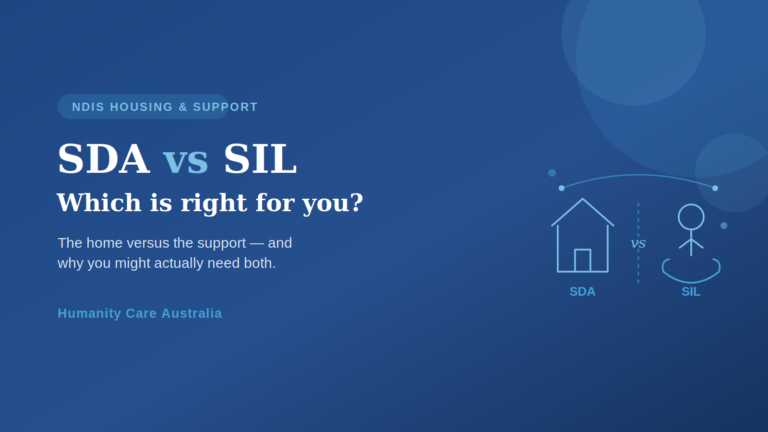
- SDA and SIL are funded separately — SDA pays for the home, while Supported Independent Living (SIL) pays for your support workers.
- SDA funding is a Capital support paid directly to the housing provider; you pay a reasonable rent contribution from your own income.
Finding the right home is one of the biggest decisions in any person’s life, and for people with significant disability it can also be one of the hardest. Specialist Disability Accommodation, usually shortened to SDA, is the part of the NDIS designed to help. It often gets confused with the support services delivered inside a home, so this guide explains what SDA actually is, who it is for, and how it fits alongside Supported Independent Living (SIL). Humanity Care Australia does not provide SDA housing, but as an Adelaide SIL provider we are often asked how the two work together — so here is a clear, plain-English overview.
SDA rules, figures and eligibility are set by the NDIS and reviewed regularly. This article is general information to help you understand the basics — always confirm current eligibility and payment details at ndis.gov.au or with your NDIS planner or support coordinator.
What is Specialist Disability Accommodation (SDA)?
SDA is a category of NDIS-funded housing built or modified with specialist design features that ordinary housing cannot provide, even with basic modifications. Think ceiling hoists, reinforced walls, wider doorways, home automation and other features that make a home genuinely safe and accessible for someone with very high needs. Crucially, SDA funds the physical dwelling — the bricks and mortar — rather than the people who provide support within it. It is governed by the NDIS (Specialist Disability Accommodation) Rules 2021, and its aim is to give eligible participants an accessible home where other supports can be delivered more safely and effectively.
SDA vs SIL: the house and the help are different things
This is the single most useful distinction to grasp. SDA is the home; SIL is the support you receive in it. They are funded through separate parts of your NDIS plan, which has a practical benefit: you can change your support provider without having to move house, and vice versa. Many people with very high support needs have both — SDA covering the specialised dwelling and SIL covering the support workers who assist with daily living. If you would like to understand the support side in depth, see our guides to what Supported Independent Living is and how SIL, SDA and ILO compare.
The four SDA design categories
Not every SDA home looks the same. The NDIS classifies dwellings into four design categories, matched to different functional needs.
| Design category | Designed for |
|---|---|
| Improved Liveability | People with sensory, cognitive or intellectual needs — better lighting, contrast and a simpler layout. |
| Fully Accessible | People with significant physical impairment, including wheelchair users — step-free access throughout. |
| Robust | People who need a very durable, safe environment, including where there are complex behavioural needs. |
| High Physical Support | People with very high physical and clinical needs — ceiling hoists, backup power and home automation. |
The category assigned to you reflects your assessed needs, and it also determines the level of SDA payment the housing provider receives.
Who is SDA for?
SDA is intentionally limited to people with the highest needs. To be eligible you generally must have extreme functional impairment or very high support needs that mean standard housing is unsafe or unsuitable even with support, and this must be assessed and included in your NDIS plan. Because the bar is high, only around 6% of NDIS participants are expected to qualify. Eligibility is not decided on a diagnosis alone; it rests on how your disability affects your daily functioning, supported by evidence from an occupational therapist and other allied health professionals. If SDA turns out not to be the right fit, there are other pathways — our overview of NDIS housing options in Adelaide walks through the alternatives.
SDA is only one piece of the picture, and the support you receive at home matters just as much as the building. Humanity Care Australia provides Supported Independent Living across Adelaide and can help you understand how SIL might work alongside your housing. Reach out for a friendly, no-obligation chat.
How SDA funding works
SDA funding behaves differently from most NDIS supports. It sits in the Capital Supports part of your plan and, rather than being money you manage yourself, it is paid directly to the registered SDA provider that owns or manages your dwelling — effectively a housing subsidy. In return, you pay a reasonable rent contribution from your own income, usually calculated as a share of the Disability Support Pension plus any Commonwealth Rent Assistance you receive. You also cover everyday living costs such as electricity and groceries, just as any tenant would. Because exact figures are indexed and change over time, check the current rate on the NDIS website rather than relying on a number you have seen quoted elsewhere.
How to explore SDA and SIL in Adelaide
If you think SDA might suit you or a family member, the starting point is a conversation with your NDIS planner or support coordinator about a home and living request, along with an occupational therapy assessment of your functional needs. From there, an SDA provider can help match you to a suitable enrolled dwelling in your approved design category. On the support side, a local SIL provider can work with you regardless of where you live. To see what daily support can look like, our guide to how SIL empowers people with disability is a good next read.
Frequently asked questions
Is SDA the same as SIL?
No. SDA is the specialist home itself, funded as a housing subsidy, while SIL is the support workers who assist you inside a home. They are funded separately in your NDIS plan, and many people with very high needs have both.
Who qualifies for SDA?
SDA is for people with extreme functional impairment or very high support needs whose needs cannot be met by standard housing, even with support. The NDIA estimates only around 6% of participants are eligible, and it must be assessed and included in your plan.
Do I pay rent in an SDA home?
Yes. You pay a reasonable rent contribution from your own income — typically a share of the Disability Support Pension plus any Commonwealth Rent Assistance — and you cover everyday costs like electricity and food. The NDIS pays the housing provider the rest.
What are the four SDA design categories?
Improved Liveability, Fully Accessible, Robust, and High Physical Support. Each is designed for different functional needs, from sensory and cognitive supports through to very high physical and clinical needs, and your assessed needs determine which applies.
Does Humanity Care provide SDA housing?
No. Humanity Care Australia is an Adelaide provider of Supported Independent Living and other disability supports, not an SDA housing provider. We can help you understand how SIL support might work alongside SDA and point you to the right people for the housing side.
How do I apply for SDA?
Start with your NDIS planner or support coordinator and an occupational therapy assessment of your functional needs. If SDA is approved and added to your plan, an SDA provider can help you find a suitable enrolled dwelling in your design category.
Wherever you live, the right support makes all the difference. If you are looking for Supported Independent Living in Adelaide, contact Humanity Care Australia for a free, confidential chat about your goals. Call our local team on 0402 990 505 or reach us online.