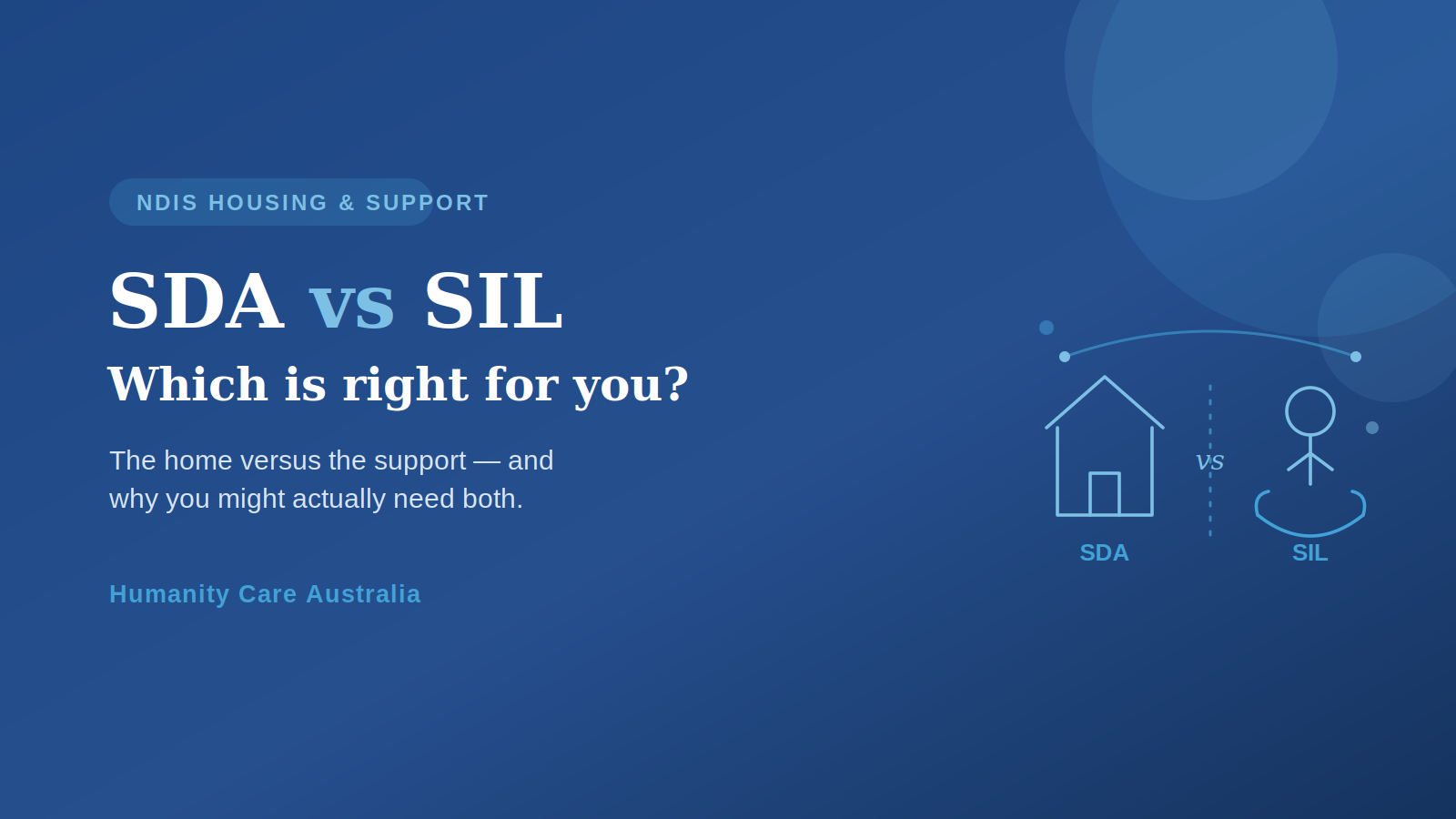
- “SDA vs SIL” is often a false choice: they fund two different things — SDA is the specialist home, SIL is the support delivered inside it.
- They sit in different parts of your NDIS plan and are assessed separately, so you can have one, both, or neither.
- Most people who need SIL do not need SDA — SIL can be delivered in a rental, a family home or your own place.
- SDA is reserved for the small group (around 6%) with extreme functional impairment or very high support needs.
- The real question is not “which one” but “what do I actually need?” — and a support coordinator can help you work that out.
If you have been researching NDIS housing, you have probably seen SDA and SIL mentioned side by side, often as though you must pick one. It is one of the most common points of confusion in the whole system — and clearing it up makes the decision much simpler. This guide explains what each one actually does, how to work out what you need, and where other options fit. For a broader comparison that also covers Individualised Living Options, see our guide to SIL, SDA and ILO.
SDA and SIL solve different problems
The single most useful thing to understand is that SDA and SIL are not competing choices — they answer different questions. SDA answers “what kind of building do I live in?” while SIL answers “what support do I receive day to day?” Because they are funded through separate parts of your NDIS plan, they are also assessed separately. That has a real practical benefit: you can change your support provider without moving house, and your housing does not depend on any one support arrangement.
| SDA | SIL | |
|---|---|---|
| What it funds | The specialist home (the building) | The support workers (the help inside) |
| Plan area | Capital supports | Core supports |
| Who it is for | Around 6% with the highest needs | People needing significant daily support |
| Paid to | The SDA housing provider | Your chosen support provider |
What SDA covers: the home
Specialist Disability Accommodation is NDIS-funded housing built or modified with features that ordinary homes cannot provide — think step-free access, ceiling hoists, reinforced construction or home automation. It is reserved for people with extreme functional impairment or very high support needs, which is why only a small share of participants qualify. If you want the full picture, our guide on what SDA is and our walk-through of SDA eligibility and how to apply cover it in detail.
What SIL covers: the support
Supported Independent Living funds the people who help you live as independently as possible — assistance with daily tasks such as personal care, cooking, medication prompts and building life skills, often in a shared arrangement and sometimes around the clock. Crucially, SIL is not tied to a particular building. It can be delivered in a home you rent, a family home, or your own place, and it is planned around a roster of the support you actually need. Our overview of what Supported Independent Living is explains how it works.
So which is right for you?
Because the two are separate, the honest answer for most people is “it depends on your needs, and it might be both”. A helpful way to think about it is to picture four situations.
SIL, not SDA
You need significant daily support but can live in standard or lightly modified housing. This is the most common situation by far.
Both SDA and SIL
You have very high needs that require both a specialist home and substantial daily support. Many SDA residents also receive SIL.
SDA, lighter support
You need a specialist dwelling but manage with less intensive or differently structured support rather than a full SIL arrangement.
Neither
Your needs are met through other supports and mainstream or modified housing. Home modifications or other options may suit better.
A practical way to place yourself is to answer the two questions separately. First, on housing: can I live safely in standard or lightly modified accommodation, or do I genuinely need specialist design features that ordinary housing cannot provide? Second, on support: how much day-to-day help do I need, and how should it be structured? Keeping the “where I live” question apart from the “what help I get” question stops the two from becoming tangled, and it usually makes the right path clearer.
Working out the right mix of housing and support is exactly what a good support coordinator helps with. Humanity Care Australia provides NDIS support coordination and Supported Independent Living across Adelaide, and we are happy to talk it through with you — no obligation.
Where ILO and other options fit
SIL is not the only support model. Individualised Living Options (ILO) offer a more flexible, tailored alternative for some people — for example, living with a host or in a shared arrangement designed around your preferences rather than a standard roster. And on the housing side, not everyone needs SDA; home modifications or other NDIS housing supports may be a better fit. Our three-way guide to SIL, SDA and ILO compares these side by side, and our overview of NDIS housing options in Adelaide maps the wider picture.
Frequently asked questions
Do I have to choose between SDA and SIL?
No. They fund different things — SDA is the home and SIL is the support inside it — so they are not alternatives. Depending on your needs you might have SIL only, both, or neither. Many people who receive SIL do not need SDA.
Can I get SIL without living in an SDA home?
Yes. SIL is not tied to a specific building. It can be delivered in a rental, a family home or your own place, because it funds the support workers rather than the property.
If I have SDA, do I automatically get SIL too?
Not automatically. SDA and SIL are assessed separately. Many people with an SDA home also receive SIL because they have high support needs, but the two funding decisions are made on their own merits.
Which one is harder to qualify for?
SDA has a higher threshold — it is reserved for around 6% of participants with extreme functional impairment or very high support needs. SIL is available to a broader group who need significant help with daily living, though it still requires evidence.
What if I need something more flexible than SIL?
Individualised Living Options (ILO) may suit you. ILO is a more tailored support model — for instance living with a host or a chosen housemate — designed around your preferences. Our SIL, SDA and ILO guide compares the options.
Does Humanity Care provide both?
Humanity Care provides Supported Independent Living and support coordination in Adelaide. We do not provide SDA housing, but our coordinators can help you understand your options and connect you with SDA providers for the housing side.
Whatever combination of housing and support suits you, the right team makes it work in practice. Contact Humanity Care Australia for a free, confidential chat about Supported Independent Living and your goals. Call our local team on 0402 990 505 or reach us online.