Finding the right home is about so much more than a roof overhead. It’s about living the way you want — with the right support, the right people, and real choice and control. For NDIS participants in Adelaide, there’s no single “housing package”; instead, there’s a range of options designed to suit different needs and goals.
This guide explains the main NDIS housing and home-and-living options in plain language, so you can work out which might be right for you or your loved one.
- The NDIS separates the home from the support — where you live is one question; the help you receive there is a separate one.
- SIL funds the support workers who help you live at home — not the house, rent or groceries.
- SDA funds the specialist building itself — purpose-built housing for people with very high support needs.
- There are more options than most people realise — including ILO, drop-in support, and transitional accommodation.
The one idea that makes NDIS housing make sense
Before the acronyms, there’s a single principle that unlocks everything: the NDIS separates housing from support. The bricks and mortar — where you live — is one question. The people and services that help you live there is a completely different question. Each NDIS option addresses a different part of that equation. Some participants use just one; many use a combination.
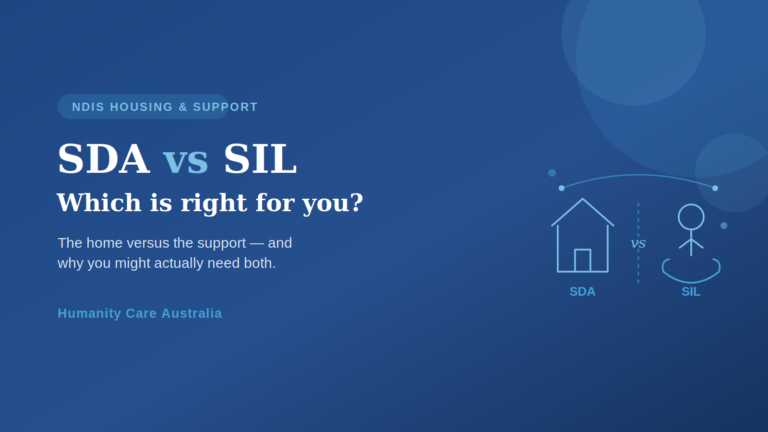
SDA is the house. SIL is the support inside it. You can have SIL without SDA, SDA without SIL, or both together (common for people with very high needs). Keeping this distinction in mind makes every other decision clearer.
The main NDIS home and living options
Here are the options you’re most likely to come across, and what each one actually funds.
Supported Independent Living (SIL)
SIL is funding for support workers to help you live as independently as possible in your home. It’s the support, not the house. SIL can cover help with personal care (showering, dressing, medication), cooking, cleaning and laundry, and building life skills like budgeting and communication. It’s most often delivered in a shared home with support staff rostered across the day, and suits people who need regular or ongoing daily support. It doesn’t cover rent or groceries.
Specialist Disability Accommodation (SDA)
SDA is funding for the physical home itself — purpose-built or specially modified housing for people with very high support needs or extreme functional impairment. Features might include wheelchair accessibility, reinforced fittings, ceiling hoists, or emergency response systems. Only a small proportion of participants are eligible for SDA, and it’s assessed separately from SIL. Many people who have SDA also receive SIL support within that home.
Individualised Living Options (ILO)
ILO funds a personalised living arrangement designed around your preferences, relationships and goals — giving you greater control over who you live with and how you’re supported. It’s a flexible, increasingly popular option for people who want a living setup tailored to them rather than a standard shared model.
Drop-in and in-home support
Not everyone needs SIL. Many people live in their own home or share with others and simply receive drop-in support — help for a set number of hours, rather than rostered staff. Since the NDIS Review, this is an increasingly common pathway, and it can be a great fit for people who need substantial help but not constant supervision.
Transitional accommodation (STA & MTA)
Short-Term Accommodation (including respite) and Medium-Term Accommodation can provide a bridge while longer-term housing is being arranged — for example, while an SDA or ILO application is being assessed.
Not sure which option fits?
Our Adelaide team can help you understand your home and living options and the support that goes with them — and provide that support when you’re ready.
Comparing the options at a glance
| Option | What it funds | Best suited to |
|---|---|---|
| SIL | Support workers in your home | People needing regular or ongoing daily support |
| SDA | The specialist building itself | People with very high or complex physical support needs |
| ILO | A personalised living arrangement | People wanting a tailored, self-directed setup |
| Drop-in support | Support for set hours (not rostered staff) | People needing substantial but not constant help |
Who pays for what?
One of the most common points of confusion is what the NDIS covers versus what you pay yourself. Here’s the general picture for supported living:
The NDIS pays
For your disability support — the support workers who help you (your SIL funding), and, if eligible, the specialist building (SDA).
You pay
For everyday living costs — rent, utilities, groceries and personal items — usually from your income and any rent assistance, just like anyone else.
From 1 July 2026, all providers delivering SIL supports must be registered with the NDIS Quality and Safeguards Commission and meet new SIL Practice Standards. This is designed to lift safety and quality across supported living. If you’re with a provider now, it’s worth checking they’re registering ahead of the deadline so your support isn’t disrupted.
How to access NDIS housing supports
Getting the right housing support in place takes planning and good evidence. A simple path looks like this:
1. Clarify your goals
Think about how and where you want to live, who with, and how much support you need day to day.
2. Gather evidence
Assessments from an occupational therapist or allied health professional strengthen your request — especially for SDA or ILO.
3. Request the right funding
Work with your planner at a plan review to seek the category that fits — SIL, SDA, ILO or support hours.
4. Find the right match
Choose providers and housing that genuinely suit your needs, compatibility and lifestyle — not just what’s available first.
A good support coordinator is invaluable here — they can help you gather evidence, navigate applications, and find arrangements that actually work for you.
Humanity Care provides Supported Independent Living and in-home support across Adelaide, and we’re happy to help you understand your options — without pressure. Our focus is the support that helps you live well, wherever you call home.
Frequently asked questions about NDIS housing in Adelaide
What’s the difference between SIL and SDA?
SDA is the house — funding for a purpose-built or specially modified building for people with very high support needs. SIL is the support — funding for the workers who help you live in that home. You can have one, the other, or both. They’re assessed and applied for separately.
Does SIL pay for my rent or groceries?
No. SIL funds the support workers who help you at home — not rent, utilities or groceries. Those everyday living costs are paid by you, usually from your income and any rent assistance, the same as they would be for anyone.
Do I have to live in a shared home to get support?
No. SIL is most often delivered in shared homes, but it’s not the only option. Many people live in their own home or share with others and receive drop-in support for set hours instead. Since the NDIS Review, drop-in support is an increasingly common pathway — you don’t need SIL to live with housemates.
Who is eligible for SDA?
SDA is for a small proportion of participants with very high or complex physical support needs, where standard housing — even with modifications — can’t safely meet their needs. Eligibility requires strong evidence, usually from an occupational therapist or allied health professional, and it must be reasonable and necessary.
What’s changing for SIL providers in 2026?
From 1 July 2026, all providers delivering SIL supports must be registered with the NDIS Quality and Safeguards Commission and meet new SIL Practice Standards. This is intended to raise safety and quality. If you’re with a provider now, check they’re registering before the deadline so your support continues uninterrupted.
Can Humanity Care help me with housing support in Adelaide?
Yes. Humanity Care provides Supported Independent Living and in-home support across Adelaide, and we’re happy to help you understand your home and living options. We focus on the support that helps you live well — and can point you to the right people for the housing side.
A home that works for you
NDIS housing can feel like a maze of acronyms, but the underlying idea is simple and hopeful: there are real choices, designed to help you live the life you want, with the right level of support. Whether that’s shared living with SIL, a purpose-built SDA home, a tailored ILO arrangement, or drop-in help in your own place — the goal is the same: a real home, and a real life.
If you’d like help understanding your options or arranging support, our friendly Adelaide team is here for a no-obligation chat.
Explore your home and living options in Adelaide
Talk to our local team about Supported Independent Living and in-home support — and we’ll help you find an arrangement that truly fits.