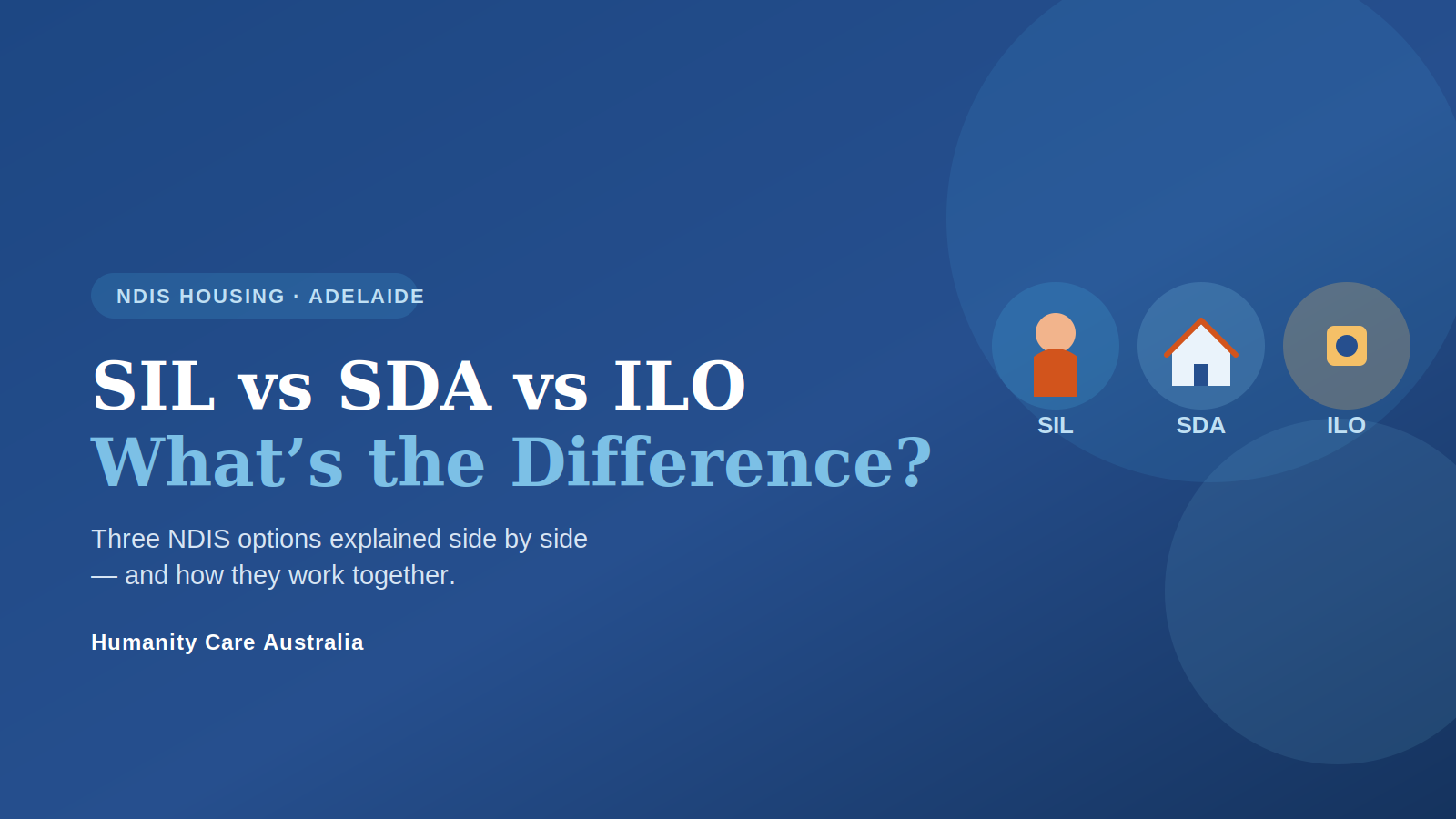
SIL, SDA, ILO — three acronyms that cause more confusion than almost anything else in the NDIS. They sound similar, they all relate to where and how you live, and they’re constantly mixed up. But they’re genuinely different things, and understanding the difference is the key to choosing the right home and living support. This guide breaks all three down in plain language, side by side.
- SIL is the support — funding for support workers to help you live independently, usually in a shared home.
- SDA is the building — funding for a purpose-built or specially modified home for very high physical support needs.
- ILO is the arrangement — funding to design a personalised living setup around your choices, blending paid and informal support.
- They can work together — you might have one, two, or all three, depending on your needs.
The one principle that clears up the confusion
Before the detail, here’s the idea that untangles everything: the NDIS separates the home from the support. SDA is about the physical home; SIL and ILO are both about the support you receive in it — just arranged differently. Once you hold onto that, the rest falls into place.
SIL, SDA and ILO side by side
| SIL | SDA | ILO | |
|---|---|---|---|
| What it funds | Support workers | The physical building | A personalised support arrangement |
| It is… | The support | The home | The arrangement |
| Typical setting | Shared home, rostered staff | Purpose-built / modified housing | Host, housemates or your own home |
| Best suited to | Regular or high daily support needs | Very high physical support needs | Moderate needs, wanting flexibility |
Supported Independent Living (SIL)
SIL is funding for support workers to help you live as independently as possible — it’s the support, not the house. It’s most often delivered in a shared home where a small group of participants share rostered staff across the day and, where needed, overnight. SIL suits people who need regular or ongoing daily support.
Want the full picture? See our guide to what SIL is and how it works.
Specialist Disability Accommodation (SDA)
SDA is funding for the physical home itself — purpose-built or specially modified housing for people with very high or complex physical support needs. Features might include wheelchair accessibility, reinforced fittings, ceiling hoists or assistive technology. Only a small proportion of participants are eligible, and it’s assessed separately. Many people who have SDA also receive SIL support inside that home — the building (SDA) and the support (SIL) funded separately but working together.
Individualised Living Options (ILO)
ILO is the most flexible of the three. Rather than moving into an existing model, ILO funds you to design your own living arrangement around your choices — where you live, who with, and how you’re supported. Crucially, it blends paid supports with informal supports from family, friends and community.
ILO is delivered in two stages:
Stage 1 — Exploration & Design
You work with a provider (often alongside your support coordinator) to explore where and how you want to live, and design a support package. This is captured in a service proposal for the NDIS.
Stage 2 — Supports
Once approved, your arrangement is put in place — combining primary supports (like a host or housemates) with supplementary supports, and reviewed over time.
ILO commonly takes the form of a host arrangement (living with a non-related host who provides company and support) or living with chosen housemates. It generally suits people with moderate daily support needs who want a tailored, self-directed setup rather than a shared rostered model.
Not sure which option is right for you?
Our Adelaide team can help you understand your home and living options and provide person-centred support built around your goals — with no pressure.
What none of them cover
Here’s a point that trips many people up: none of these options pay for your everyday living costs. Across SIL, SDA and ILO:
- Rent and mortgage are not covered by SIL or ILO (SDA relates to the specialist building, but you may still contribute a reasonable rent).
- Utilities like electricity, gas and water are paid by you.
- Groceries, meals and personal items are your everyday costs, the same as for anyone.
These are met from your income and any rent assistance. The NDIS funds the disability-related support and, where eligible, the specialist building — not the ordinary costs of living.
How they can work together
These options aren’t mutually exclusive. Depending on your needs, you might combine them:
SIL + SDA
Common for people with very high needs — the specialist home (SDA) plus rostered support (SIL) inside it.
ILO on its own
A personalised arrangement (host or housemates) for someone with moderate needs wanting flexibility.
SIL on its own
Rostered support in a regular (non-SDA) shared home — the most common SIL arrangement.
ILO within SDA
In some cases, an ILO arrangement can be delivered within an SDA home — flexibility inside specialist housing.
Frequently asked questions about SIL, SDA and ILO
What’s the difference between SIL, SDA and ILO?
SIL funds support workers (usually in a shared home). SDA funds the physical specialist building for people with very high physical needs. ILO funds a personalised living arrangement designed around your choices, blending paid and informal support. In short: SDA is the home; SIL and ILO are two different ways of arranging the support.
Can I have SIL and SDA at the same time?
Yes. This is common for people with very high needs — SDA funds the specialist home, and SIL funds the support workers inside it. They’re assessed and funded separately but work together. You can also have SIL without SDA, which is the most common arrangement.
Is ILO better than SIL?
Neither is better overall — it depends on your needs. SIL suits people who need a high level of daily support, often in a shared home with rostered staff. ILO suits people with moderate needs who want more choice over where and how they live. A support coordinator can help you work out which fits your situation.
Does SDA include support workers?
No. SDA funds only the physical building — the accessible, purpose-built or modified home. It does not fund support workers. If you need daily support in an SDA home, that’s funded separately, usually through SIL. The two are designed to work together for people with very high needs.
What is a host arrangement in ILO?
A host arrangement is one way ILO can be structured: you live in the home of a non-related host who provides company and support, in return for payment or reimbursement, often alongside formal supports. It’s one of several flexible ILO options — others include living with chosen housemates or in your own home with supports coming in.
Do any of these pay my rent?
No. SIL and ILO fund support, not rent, utilities or groceries. SDA relates to the specialist building, but you may still contribute a reasonable rent. Everyday living costs are paid by you, usually from your income and any rent assistance — the same as for anyone.
The right fit is personal
SIL, SDA and ILO exist because there’s no single right way to live — and the NDIS increasingly recognises that. The best option depends entirely on your support needs, your goals, and how you want to live. Understanding the difference is the first step; the next is working out which combination genuinely fits you.
If you’d like help understanding your home and living options in Adelaide, our friendly local team is here for a no-obligation chat.
Understand your home and living options
Talk to our local Adelaide team about SIL and in-home support — and we’ll help you understand how the options fit together for you.