Moving towards more independent living is one of the biggest, most hopeful steps a person with disability can take — but the acronyms don’t make it easy. Supported Independent Living, or SIL, is one of the most common and most misunderstood NDIS supports. This guide answers the question plainly: what is SIL, how does it work, what does it fund (and not fund), and how do you access it?
- SIL is the support, not the house — it funds the support workers who help you live independently, not rent, groceries or the building.
- It’s usually shared — most often delivered in a home with a small group of participants sharing rostered staff.
- SIL and SDA are different — SIL is the support; SDA is the specialist building. You can have one, the other, or both.
- It’s for higher, ongoing needs — if you need less help, drop-in support may suit you better than SIL.
What is Supported Independent Living (SIL)?
SIL is NDIS funding for support workers to help you live as independently as possible in your home. Here’s the single most important thing to understand: SIL is the support, not the house. It doesn’t pay for your rent, your groceries or the building — it pays for the people who help you day to day.
SIL is most often delivered in a shared home, where a small group of participants live together and share rostered support staff across the day and, where needed, overnight. It suits people who need regular or ongoing daily support to live safely and well.
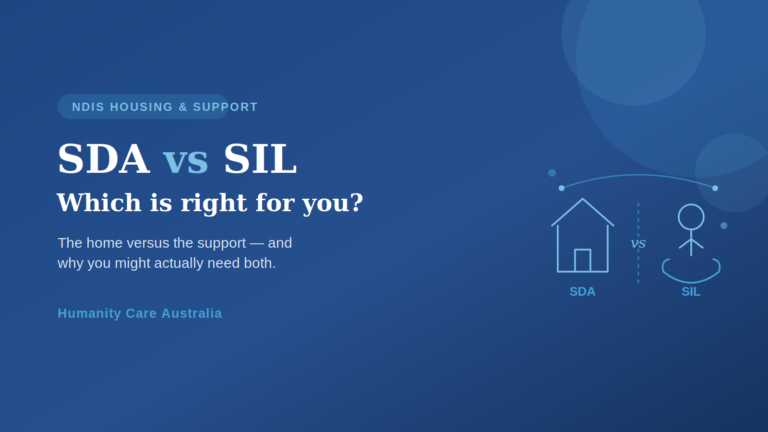
SDA is the house. SIL is the support inside it. You can have SIL on its own, or alongside Specialist Disability Accommodation (SDA) if you have very high physical support needs. Most people who receive SIL don’t have SDA — they live in regular housing with SIL support.
What does SIL support include?
SIL is built around your daily life and the things you need help with to live independently. It commonly includes:
Personal care
Help with showering, dressing, grooming and medication, delivered with dignity.
Household tasks
Cooking, cleaning, laundry and keeping your home safe and comfortable.
Daily routines
Support and supervision through the morning, evening and overnight as needed.
Building life skills
Budgeting, communication and cooking — skills that grow your independence over time.
Crucially, good SIL isn’t just about doing things for you — it’s about building your confidence and skills so you can do more for yourself over time.
What SIL doesn’t cover
This is where a lot of confusion arises. SIL funds the support workers — it does not pay for:
| SIL funds (the support) | You pay (everyday living costs) |
|---|---|
| Support workers who help you day to day | Rent or mortgage, and the building itself |
| Personal care, household tasks, routines | Utilities — electricity, gas and water |
| Building your daily living skills | Groceries, meals and personal items |
These everyday living costs are paid by you — usually from your income and any rent assistance, the same as they would be for anyone. If you have very high physical support needs, the specialist building itself may be funded separately through SDA, which is assessed on its own.
SIL vs SDA: what’s the difference?
Because these two are so often confused, here’s the difference at a glance:
| SIL | SDA | |
|---|---|---|
| What it funds | The support workers who help you | The specialist building itself |
| It is… | The people / support | The bricks and mortar |
| Best for | Regular or ongoing daily support | Very high or complex physical needs |
Thinking about supported independent living?
Our Adelaide team provides SIL support built around your goals and daily life. We’re happy to talk through whether SIL is the right fit — with no pressure.
How much support does SIL provide?
SIL is tailored to how much help you actually need. Support is usually described in two ways:
- Shared support (e.g. 1:3) — one worker supports a few participants in a shared home, such as during quieter times, evenings and overnight. This is more cost-effective and common.
- One-to-one support (1:1) — a worker dedicated just to you, usually for higher-intensity tasks or times when you need focused help.
The exact mix is set out in a document your provider prepares, which breaks your week into support blocks so your funding reflects your genuine needs. A support coordinator can help make sure this is accurate and fair.
Who is SIL for?
SIL is designed for people who need substantial, regular support to live independently — not just a few hours here and there. It’s worth knowing that SIL isn’t the only path to independent living.
If you only need a smaller amount of help, or you choose and manage your own support workers, that’s usually delivered as drop-in support rather than SIL. Many people live well with drop-in support and don’t need a full SIL arrangement — and you don’t need SIL to live with housemates. It’s always worth exploring which option genuinely fits your needs.
How is SIL funded and set up?
Getting SIL into your plan takes evidence and planning. The general path looks like this:
1. Clarify your goals
How and where you want to live, and the support you need to do it safely.
2. Gather evidence
Assessments from occupational therapists or allied health professionals showing your support needs.
3. Request funding
At your plan review, work with your planner to seek SIL funding based on that evidence.
4. Find the right match
Choose a home and provider that suit your needs, compatibility and lifestyle — not just what’s available first.
A good support coordinator is invaluable through this process — helping you gather evidence, navigate the application, and find an arrangement that genuinely works.
From 1 July 2026, all providers delivering SIL supports must be registered with the NDIS Quality and Safeguards Commission and meet new SIL Practice Standards. This is designed to lift safety and quality across supported living. If you’re with a provider now, it’s worth checking they’re registering ahead of the deadline so your support isn’t disrupted.
Choosing a SIL provider in Adelaide
The right provider makes an enormous difference to how supported living actually feels. Some things worth looking for:
- Genuine person-centred support — built around your goals, not a one-size-fits-all model.
- Skilled, screened workers — trained staff who treat you with respect and consistency.
- Good housemate matching — care taken over compatibility if you’re sharing a home.
- Registration and quality — a registered provider held to the NDIS Practice Standards.
Humanity Care provides person-centred Supported Independent Living support across Adelaide, delivered by trained, screened workers who focus on your goals, safety and independence. We’re a registered NDIS provider, and we’re happy to help you understand whether SIL is the right fit — and connect you with the right people for the housing side.
Frequently asked questions about SIL
What is Supported Independent Living (SIL)?
SIL is NDIS funding for support workers to help you live as independently as possible in your home. It covers help with personal care, household tasks, daily routines and building life skills. It’s the support, not the house — and is most often delivered in a shared home with rostered staff.
Does SIL pay for rent or groceries?
No. SIL funds the support workers who help you — not rent, utilities or groceries. Those everyday living costs are paid by you, usually from your income and any rent assistance.
What’s the difference between SIL and SDA?
SDA is the house — funding for a purpose-built or specially modified home for people with very high support needs. SIL is the support — funding for the workers who help you live there. You can have one, the other, or both, and they’re assessed separately.
Do I have to live in a shared home to get SIL?
SIL is most often delivered in shared homes, but not always. If you need less support, or manage your own workers, drop-in support may suit you better. You don’t need SIL to live with housemates.
What’s changing for SIL in 2026?
From 1 July 2026, all SIL providers must be registered with the NDIS Quality and Safeguards Commission and meet new SIL Practice Standards. If you’re with a provider now, check they’re registering before the deadline so your support continues uninterrupted.
Does Humanity Care provide SIL in Adelaide?
Yes. Humanity Care provides person-centred SIL support across Adelaide, delivered by trained, screened workers. We’re a registered NDIS provider and are happy to talk through whether SIL is the right fit for you.
A real home, and a real life
Supported Independent Living, at its best, isn’t about recreating a bedroom with paid staff — it’s about a real home and a real life, with exactly the right support around you. For many Adelaide participants, SIL is the arrangement that finally makes independent living possible, safe and genuinely enjoyable.
If you’d like to explore whether SIL is right for you or your loved one, our friendly local team is here for a no-obligation chat.
Explore Supported Independent Living in Adelaide
Talk to our local team about SIL support built around your goals — and we’ll help you understand your options and take the next step.