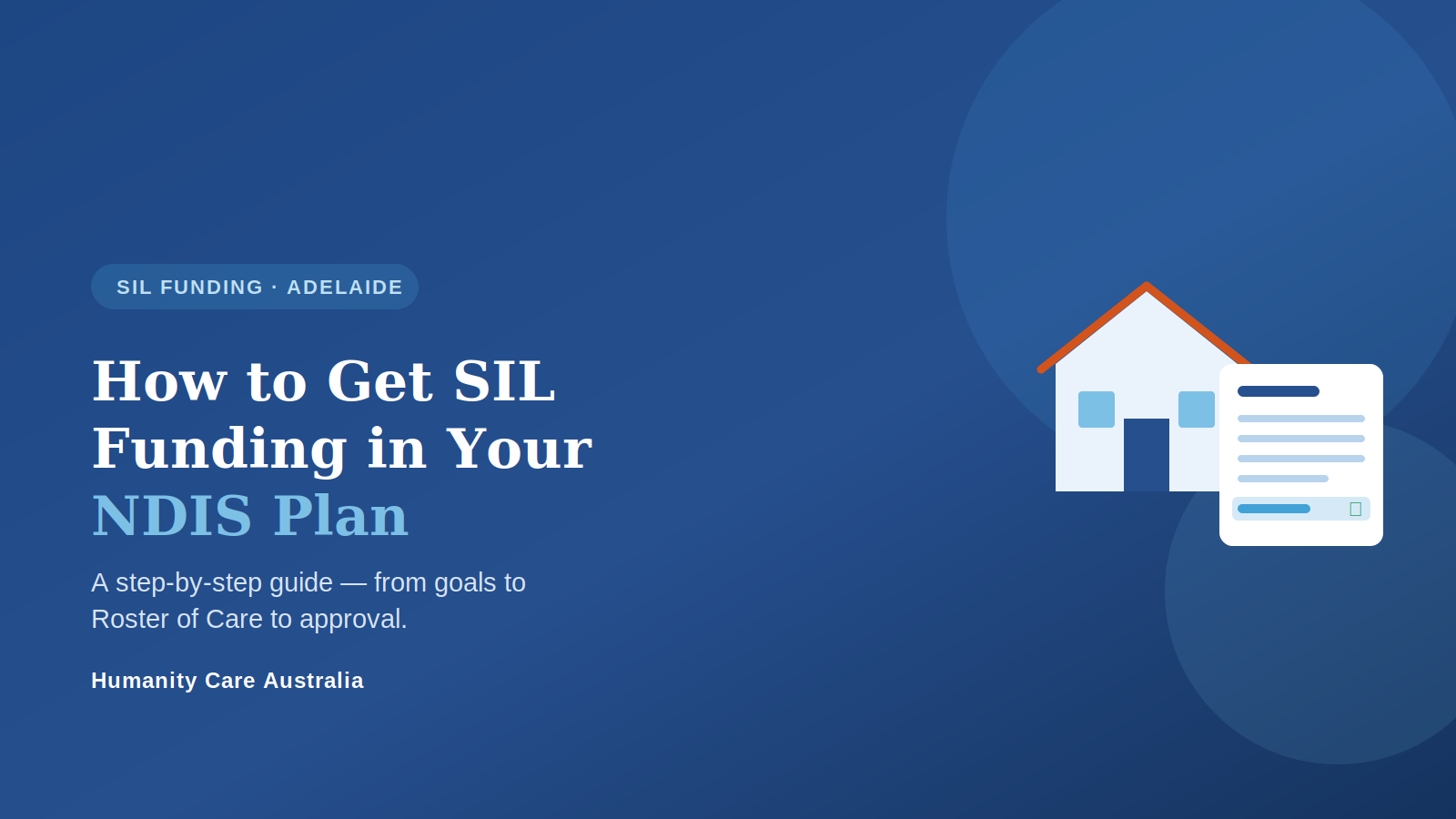
Supported Independent Living (SIL) can be life-changing — the support you need to live independently in your own home or a shared house. But before you can move in, SIL funding has to be approved in your NDIS plan. The process can look daunting, but it really comes down to one thing: showing the NDIS, with good evidence, that SIL is reasonable and necessary for you. This guide breaks the process into clear steps.
- SIL funding is evidence-driven — the goal is to show it’s reasonable and necessary for you.
- An OT assessment and a Roster of Care are central — these are the key documents.
- You’ll work with a support coordinator — everyone funded for SIL is also funded for one.
- Start early — the process typically takes a few months from assessment to decision.
Before you start: what SIL funding is (and isn’t)
SIL is funding for support workers to help you with daily tasks at home — things like personal care, meal preparation, and support to live safely and build independence. It’s generally for people with higher support needs who need help or supervision at home much of the time. Importantly, SIL doesn’t cover rent, groceries or other everyday living costs — just the disability support. For the full picture, see our guide to what SIL is and how it works.
The 5 steps to getting SIL funding
Here’s the process from start to finish.
Step 1: Set a home and living goal
The first step is having a relevant goal in your NDIS plan — something about living independently. If you don’t have one, you can request a plan review. Examples of the kind of goal that opens the door:
- “My goal is to live more independently in the community.”
- “I want to build my skills to manage my own home with the right support.”
- “I want to explore my options for moving out of my family home.”
This goal “unlocks” the possibility of SIL funding and the assessments that come next.
Step 2: Engage a support coordinator
Don’t try to navigate the SIL process alone. A support coordinator acts as your project manager for the whole application — helping you find a qualified occupational therapist, coordinate with a SIL provider, and pull the evidence together. Everyone funded for SIL is also funded for a support coordinator, so use them.
Step 3: Get a functional assessment (OT report)
This is the evidence foundation. An occupational therapist (OT) experienced in housing assessments completes a functional capacity assessment. Their report recommends the right support model for you, the level of support you need at different times of day (and overnight), and explains why other options aren’t as suitable. Good evidence links your daily tasks to time, frequency, risk and support type.
Step 4: Develop the Roster of Care
The Roster of Care is the core SIL document. It’s a spreadsheet, prepared by your SIL provider with you and your support coordinator, that maps the support you need across a typical week — broken into blocks, showing what help you need and when, and (in shared homes) the staffing ratio at each point. The NDIA uses it to work out how much funding is needed.
Step 5: Submit and await the NDIS decision
Your Roster of Care and supporting evidence (the OT report and any other relevant reports) are submitted to the NDIA, usually alongside a Home and Living Supports request. The NDIA’s SIL team reviews it all, may ask for more information, and then makes a funding decision that’s confirmed in your plan.
Better evidence beats more evidence. A report that clearly links each daily task to the time it takes, how often it’s needed, the risk involved, and the type of support required is far stronger than a thick bundle that never quite answers the key question: what would happen without this support?
Thinking about SIL?
If you have a home and living goal in your plan, our Adelaide team can help you understand the process, work with your support coordinator, and develop a Roster of Care that reflects your real needs.
What evidence strengthens your application?
Beyond the OT report and Roster of Care, other evidence can help build a strong case:
Allied health reports
Reports from other professionals involved in your care that describe your needs and risks.
Behaviour support information
Where relevant, information from a behaviour support practitioner about your support needs.
A clear picture of your week
What a typical day and week look like — morning routines, meals, personal care, overnight needs.
Informal support details
What help family or friends can (and can’t) provide — the NDIA factors this in.
How long does it take?
The full process — from starting assessments to receiving a decision — typically takes a few months, often around two to four. That includes time for the OT assessment, report writing, and the NDIA’s review. Complex situations can take longer, so it’s wise to start early, especially if your current living situation is unstable.
SIL is an evolving area — provider registration and claiming rules changed from 1 July 2026, and NDIS home and living processes continue to develop. It’s worth confirming the current process with the NDIS or your support coordinator, and choosing a provider who’s staying across the changes.
Humanity Care provides Supported Independent Living across Adelaide. We work closely with participants, families and support coordinators to develop a Roster of Care that genuinely reflects the person’s life — not just hours on a spreadsheet — and to deliver support that helps them live well at home.
Frequently asked questions about SIL funding
How do I get SIL funding added to my NDIS plan?
The process has five broad steps: set a home and living goal, engage a support coordinator, get an OT functional assessment, develop a Roster of Care with your SIL provider, and submit it with supporting evidence for the NDIA to review. It all comes down to showing SIL is reasonable and necessary for you.
What is a Roster of Care?
A Roster of Care is the core SIL document — a spreadsheet that maps the support you need across a typical week, in blocks, showing what help you need and when (and the staffing ratio in shared homes). Your SIL provider prepares it with you and your support coordinator, and the NDIA uses it to determine your funding.
Do I need an OT assessment for SIL?
Yes, generally. A functional capacity assessment from an occupational therapist experienced in housing is central evidence. The OT recommends the right support model, the level of support you need at different times, and explains why other options aren’t as suitable — giving the NDIA what it needs to decide.
How long does it take to get SIL funding approved?
Typically a few months from starting assessments to a decision — often around two to four — allowing for the OT assessment, report preparation and the NDIA review. Complex cases can take longer, so it’s best to start early, especially if your current living situation isn’t stable.
Can I get SIL funding to live alone?
SIL can be approved for both shared and solo living, depending on your needs. Living alone usually requires stronger justification — evidence of why shared living isn’t suitable for you. The key, as always, is demonstrating that the support model you’re requesting is reasonable and necessary.
Can Humanity Care help with my SIL application in Adelaide?
Yes. If you have a home and living goal in your plan, Humanity Care can help you understand the process, work alongside your support coordinator, and develop a Roster of Care that reflects your real needs. Get in touch for a no-obligation chat about how we can help.
Worth the effort
Getting SIL funding takes preparation — a clear goal, a good OT assessment, and a Roster of Care that accurately reflects your needs. But for many people, it’s the key that unlocks a more independent life at home. The stronger and clearer your evidence, the smoother the path.
If you’d like help exploring SIL in Adelaide, or you’re ready to start the process, our friendly local team is here to help.
Start your SIL journey in Adelaide
Talk to our local team about SIL and how to build a strong application — with no obligation.