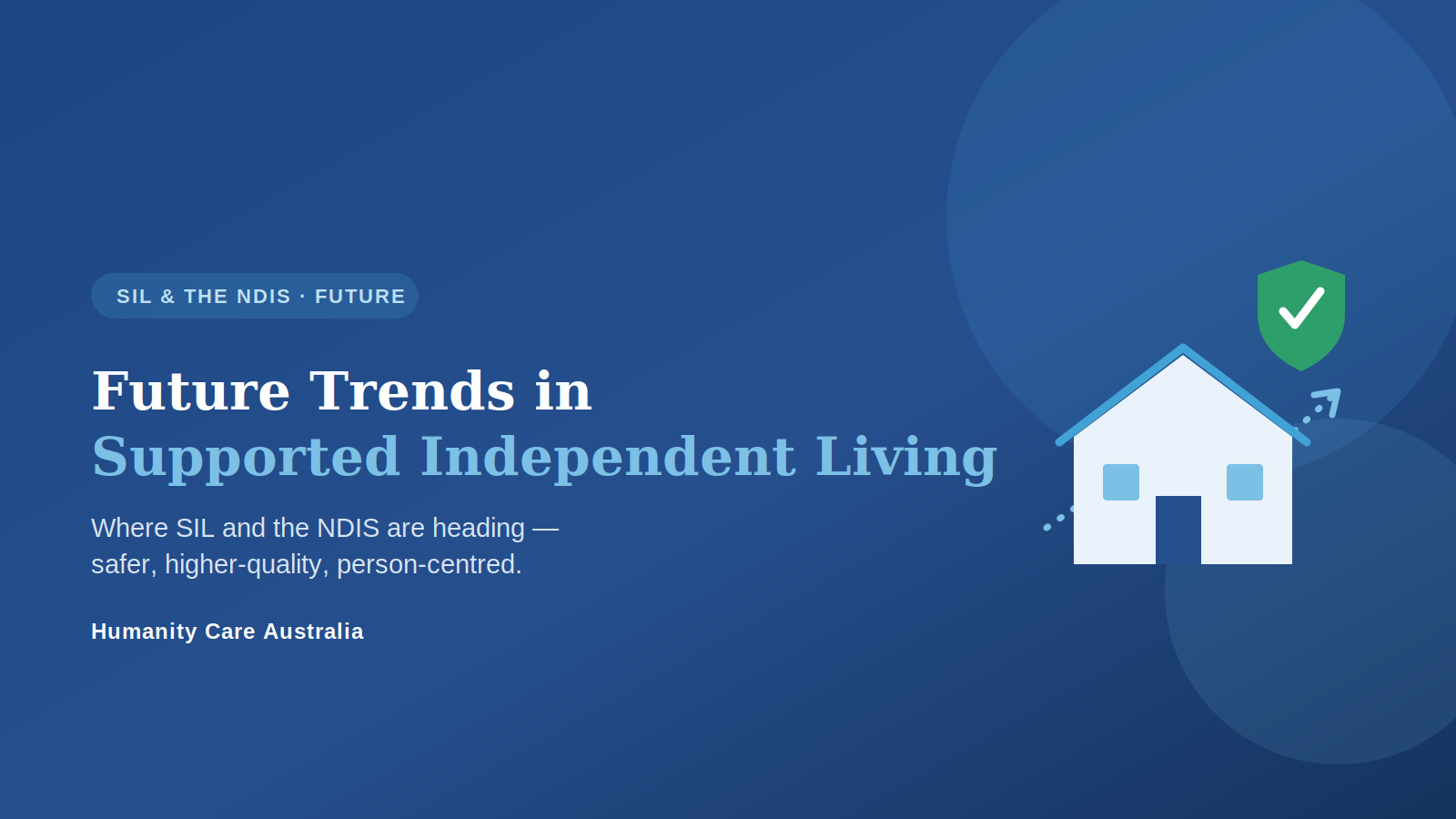
Supported Independent Living (SIL) is evolving. Driven by major reviews, new regulations and changing expectations, the way SIL is delivered in Australia is shifting — and mostly in ways that are good news for participants. If you’re living in SIL, considering it, or supporting someone who is, it helps to understand where things are heading. This guide looks at the key future trends shaping Supported Independent Living and the NDIS.
- Quality and safety are being strengthened — through new standards and mandatory provider registration.
- The participant voice is central — new standards were co-designed with people with disability.
- Person-centred, individualised support is the direction — away from one-size-fits-all models.
- Broader NDIS reforms are underway — changing how planning and home-and-living supports work.
A sector focused on quality and safety
The biggest trend shaping SIL is a strong, sector-wide push toward higher quality and safety. Reviews including the NDIS Review and the Disability Royal Commission highlighted real risks in some supported accommodation settings — and the response has been decisive: tighter regulation, clearer standards, and greater oversight of the providers delivering these vital supports.
For participants, this is genuinely reassuring. It means a future where the quality and safety of SIL homes is held to a higher, more consistent standard — reducing the risk of poor-quality or unsafe support.
A landmark change: from 1 July 2026, providers delivering SIL must be registered with the NDIS Quality and Safeguards Commission (with transitional arrangements for existing providers). Registration means meeting strict standards, audits and safeguards. Crucially, this is a safety and quality reform for providers — your NDIS plan, SIL funding and eligibility are not changing. It’s about making sure SIL is delivered safely and well.
New, co-designed standards
Alongside registration, new quality standards specifically for SIL are being introduced. What’s notable is how they were developed: co-designed with people with disability, so the participant voice sits at the heart of them rather than being added as an afterthought. This reflects a broader and very welcome trend across the sector — designing supports with people, not just for them.
The new standards focus on quality and safety in shared living, and on giving frontline workers clearer guidance on what good support actually looks like day to day.
Toward more person-centred, individualised support
The clear direction of travel is away from rigid, one-size-fits-all models and toward support built around the individual. Increasingly, SIL is expected to genuinely reflect each person’s goals, preferences and choices — not slot them into a standard template. This aligns with the whole philosophy of the NDIS: person-centred care, choice and control.
Individual choice
Growing emphasis on participants choosing where and how they live, and who they live with.
Independence focus
Support increasingly geared toward building skills and independence, not fostering dependence.
Quality of life
A shift from simply meeting basic needs toward supporting genuinely good, connected lives.
Participant voice
People with disability increasingly shaping the supports and systems that affect them.
A registered SIL provider you can trust
Humanity Care is a registered NDIS provider delivering person-centred SIL across Adelaide — already meeting the standards that safeguard your support, now and into the future.
Broader NDIS reforms on the horizon
SIL doesn’t exist in isolation — it’s part of a wider NDIS that’s undergoing significant reform. Several broader changes are being developed that will shape the future of home and living supports:
- New framework planning — a new approach to how NDIS plans are built, rolling out progressively over the coming years.
- Functional-capacity eligibility — changes to how eligibility is assessed, focused on functional impact.
- Home and living reform — new approaches to how home and living supports (including SIL) are designed and delivered.
- Stronger fraud and compliance measures — protecting the scheme and the people who rely on it.
These broader reforms are being rolled out gradually, with consultation involving people with disability and the sector. Timeframes and details continue to evolve, so it’s wise to rely on official sources — the NDIS and NDIS Commission websites — for the latest, and to talk to your provider or support coordinator about what any changes mean for you specifically.
What these trends mean for participants
Taken together, the direction is positive. The future of SIL points toward safer, higher-quality, more person-centred support, with participants’ voices increasingly central. For people living in or considering SIL, that’s genuinely encouraging — a future where SIL better delivers on its real promise: helping people live independent, connected, self-directed lives.
As a registered NDIS provider, Humanity Care already meets the standards these reforms are strengthening. We deliver person-centred Supported Independent Living across Adelaide, built around each resident’s goals and choices — and we stay across the changes so you don’t have to. Your support is in safe, registered hands.
Frequently asked questions about the future of SIL
What are the main trends shaping the future of SIL?
Key trends include a strong push toward higher quality and safety (through new standards and mandatory provider registration), new standards co-designed with people with disability, a shift toward more person-centred and individualised support, and broader NDIS reforms changing how planning and home-and-living supports work. Overall, the direction is safer, higher-quality, more person-centred SIL.
Do SIL providers now have to be registered?
Yes. From 1 July 2026, providers delivering SIL must be registered with the NDIS Quality and Safeguards Commission, with transitional arrangements for existing providers. Registration means meeting strict standards, audits and safeguards. It’s a safety and quality reform aimed at making sure SIL is delivered well — your NDIS plan and funding are not affected.
Will these changes affect my NDIS plan or funding?
The SIL registration reform is about providers, not participant funding — your NDIS plan, SIL funding and eligibility are not changing because of it. Broader NDIS reforms (like new framework planning) are being rolled out gradually with consultation. For anything specific to your situation, check official NDIS sources and talk to your provider or support coordinator.
What should I do if my SIL provider isn’t registered?
Ask your provider directly whether they’re registered or applying to register. Existing providers can continue during the transition if they apply within the required timeframe, but if a provider doesn’t register, you may need to move to a registered one. You can verify a provider’s registration on the NDIS Commission website, and your support coordinator can help you plan.
Are the changes good or bad for participants?
On balance, positive. The trends point toward safer, higher-quality, more person-centred SIL, with participants’ voices increasingly central — including standards co-designed with people with disability. There may be some short-term adjustment (for example, if a provider doesn’t register), but the overall direction better delivers on SIL’s promise of independent, connected living.
Is Humanity Care a registered SIL provider?
Yes. Humanity Care is a registered NDIS provider delivering person-centred Supported Independent Living across Adelaide, already meeting the standards these reforms are strengthening. Get in touch for a no-obligation chat about SIL support you can trust, now and into the future.
A positive direction for supported living
The future of Supported Independent Living is being shaped by a clear goal: making it safer, higher in quality, and more genuinely centred on the people it serves. For participants and families, that’s a hopeful direction — a future where SIL delivers ever more fully on its promise of dignity, independence and a good life.
If you’d like to explore trusted, registered SIL support in Adelaide, our friendly local team is here to help.
Explore trusted SIL in Adelaide
Talk to our local team about registered, person-centred Supported Independent Living — built for today and the future, with no obligation.