Humanity Care Australia Logo
  • Disability Services
    Home & Living
    • Supported Independent Living (SIL)24/7 support in safe, shared Adelaide homes with vacancies matched to your needs.
    • Personal Care & Daily LivingRespectful help with hygiene, grooming and mobility in your own home.
    • Household TasksCleaning, laundry and meal prep for a safe, stress-free home.
    Community & Skills
    • Community ParticipationOne-on-one and group support to join clubs, events and hobbies across Adelaide.
    • Daily Living & Life SkillsBuild independence in cooking, budgeting, travel and more.
    • Day ProgramsA structured routine of skill-building, social activities and outings.
    • Group & Centre-Based ActivitiesFun group sessions, from art and cooking to games and social events.
    • NDIS Transport AssistanceSafe, reliable, door-to-door transport for appointments and outings.
    Support & Care
    • NDIS Support CoordinationNavigate your plan, connect with providers and maximise your budget.
    • Disability Support WorkersQualified, vetted support workers carefully matched to your goals.
    • NDIS PhysiotherapyMobility, strength, balance and independence through evidence-based physio.
    • Respite CareShort-term respite that gives family carers a genuine, restful break.
    Getting Started
    • Check Your EligibilityA plain-English guide to NDIS and aged care eligibility in Adelaide.
    • View All ServicesBrowse our full range of disability support across Adelaide.
  • Aged-Care
    Our Services
    • Aged Care ServicesYour complete aged care solution — in-home support, residential care and respite across Adelaide.
    • In-Home Aged CarePersonal care, meals and companionship so you can live with dignity at home.
    • Residential Aged Care24/7 nursing and support in a warm, home-like community including specialist dementia care.
    • Respite CareShort-term respite that gives family carers a genuine, restful break.
    Funding Options
    • Support at HomeReplaced Home Care Packages from Nov 2025 — flexible in-home funding for higher needs.
    • CHSP — Entry-Level SupportCommonwealth Home Support Programme — subsidised everyday help to keep you at home.
    • Private Aged CareNo waiting for funding — flexible private in-home care that starts straight away.
    Why Humanity Care
    • Trilogy Care Partnership30+ years combined experience and low fees — more of your budget on your care.
    • Qualified Local TeamEnrolled Nurses and Cert III/IV carers, fluent in Arabic, Dari, Persian and Urdu.
    • Am I Eligible?Understand if you qualify for government-funded aged care support in Adelaide.
    Getting Started
    • Check Your EligibilityFind out if you qualify for government-funded aged care support in Adelaide.
    • Talk to Our TeamCall 0402 990 505 for a free, friendly chat about aged care in Adelaide.
    • View All Aged Care ServicesBrowse our complete aged care offering across Adelaide.
  • About
    • About Us
    • Meet Our Team
    • Jobs
    • Contact
  • Blog
040 299 0505 Check Eligibility
Humanity Care Australia Logo
  • Blog
Check Eligibility
Disability Services
Home & Living
  • Supported Independent Living (SIL)24/7 support in safe, shared Adelaide homes with vacancies matched to your needs.
  • Personal Care & Daily LivingRespectful help with hygiene, grooming and mobility in your own home.
  • Household TasksCleaning, laundry and meal prep for a safe, stress-free home.
Community & Skills
  • Community ParticipationOne-on-one and group support to join clubs, events and hobbies across Adelaide.
  • Daily Living & Life SkillsBuild independence in cooking, budgeting, travel and more.
  • Day ProgramsA structured routine of skill-building, social activities and outings.
  • Group & Centre-Based ActivitiesFun group sessions, from art and cooking to games and social events.
  • NDIS Transport AssistanceSafe, reliable, door-to-door transport for appointments and outings.
Support & Care
  • NDIS Support CoordinationNavigate your plan, connect with providers and maximise your budget.
  • Disability Support WorkersQualified, vetted support workers carefully matched to your goals.
  • NDIS PhysiotherapyMobility, strength, balance and independence through evidence-based physio.
  • Respite CareShort-term respite that gives family carers a genuine, restful break.
Getting Started
  • Check Your EligibilityA plain-English guide to NDIS and aged care eligibility in Adelaide.
  • View All ServicesBrowse our full range of disability support across Adelaide.
Aged-Care
Our Services
  • Aged Care ServicesYour complete aged care solution — in-home support, residential care and respite across Adelaide.
  • In-Home Aged CarePersonal care, meals and companionship so you can live with dignity at home.
  • Residential Aged Care24/7 nursing and support in a warm, home-like community including specialist dementia care.
  • Respite CareShort-term respite that gives family carers a genuine, restful break.
Funding Options
  • Support at HomeReplaced Home Care Packages from Nov 2025 — flexible in-home funding for higher needs.
  • CHSP — Entry-Level SupportCommonwealth Home Support Programme — subsidised everyday help to keep you at home.
  • Private Aged CareNo waiting for funding — flexible private in-home care that starts straight away.
Why Humanity Care
  • Trilogy Care Partnership30+ years combined experience and low fees — more of your budget on your care.
  • Qualified Local TeamEnrolled Nurses and Cert III/IV carers, fluent in Arabic, Dari, Persian and Urdu.
  • Am I Eligible?Understand if you qualify for government-funded aged care support in Adelaide.
Getting Started
  • Check Your EligibilityFind out if you qualify for government-funded aged care support in Adelaide.
  • Talk to Our TeamCall 0402 990 505 for a free, friendly chat about aged care in Adelaide.
  • View All Aged Care ServicesBrowse our complete aged care offering across Adelaide.
About
  • About Us
  • Meet Our Team
  • Jobs
  • Contact
  1. Home
  2. Blog
All Resources Blogs
A day in the life of a SIL home - a warm, welcoming home with lit windows representing daily life in supported living

A Day in the Life of a SIL Home

What is life really like in a Supported Independent Living (SIL) home? Warmer and more ordinary than many expect -…

Read More
What to look for in an NDIS household task provider - a clean home with a checklist for choosing a trusted provider

What to Look for in an NDIS Household Task Provider

Choosing an NDIS household task provider matters - because the support happens in your home. Look for properly screened, trained…

Read More
In-home care vs residential aged care in Adelaide - a home and an aged care building compared side by side

In-Home Care vs Residential Aged Care in Adelaide

Should your loved one stay at home with support, or move into residential aged care? In-home care (via Support at…

Read More
Understanding psychosocial disability - a growing plant representing recovery and hope in mental health

Understanding Psychosocial Disability: A Recovery-Focused Guide

Psychosocial disability is the disability that can arise from a mental health condition - the way it affects everyday life.…

Read More
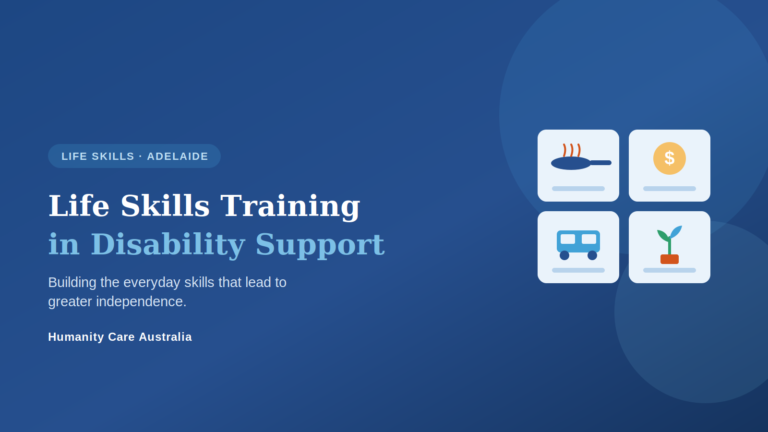
Life skills training in disability support - tiles showing cooking, budgeting, travel and personal growth skills

Life Skills Training in Disability Support: A Guide

Life skills training helps people with disability build the practical abilities of everyday life - cooking, budgeting, travel, self-care -…

Read More
How to get SIL funding in your NDIS plan - a house with a Roster of Care document and funding approved

How to Get SIL Funding Added to Your NDIS Plan

SIL funding isn't automatic - you have to show the NDIS it's reasonable and necessary. The process has five steps:…

Read More
ADHD understanding its status as a disability - a head with a dynamic brain motif representing ADHD

ADHD: Understanding Its Status as a Disability

Is ADHD a disability? Broadly yes - it's recognised under the Disability Discrimination Act, protecting people in work and education.…

Read More
How to apply for a My Aged Care assessment - an aged care assessor visiting an older person at home with a clipboard

How to Apply for a My Aged Care Assessment in Adelaide

An aged care assessment is the essential first step to accessing government-subsidised aged care - and it's free. Start by…

Read More
10-point checklist for choosing a SIL provider in Adelaide - a home with a ticked checklist clipboard

A 10-Point Checklist for Choosing the Best SIL Provider in Adelaide

Choosing a SIL provider shapes your home and daily life, so it's worth getting right. This 10-point checklist covers what…

Read More
Humanity Care Australia

Adelaide’s trusted NDIS provider

Netley Office 8 Lilac Place, Netley SA 5037, Australia
Davoren Park Office 23 Edgecombe Road, Davoren Park SA 5113, Australia
[email protected] 0402 990 505

Trust & Accreditation

NDIS Registered Provider

Find us in Adelaide

Our Services

Home & Living
  • Supported Independent Living (SIL)
  • Personal Care & Daily Living
  • Household Tasks
Community & Skills
  • Community Participation
  • Daily Living & Life Skills
  • Day Programs
  • Group & Centre-Based Activities
  • NDIS Transport Assistance
Support & Care
  • NDIS Support Coordination
  • Disability Support Workers
  • NDIS Physiotherapy
  • Respite Care
Getting Started
  • Check Your Eligibility
  • View All Services
Our Services
  • Aged Care Services
  • In-Home Aged Care
  • Residential Aged Care
  • Respite Care
Funding Options
  • Support at Home
  • CHSP — Entry-Level Support
  • Private Aged Care
© Humanity Care Australia 2026 · Registered NDIS Provider (ABN 29 206 695 744) · All rights reserved.
Privacy Policy | Terms & Conditions
Accessibility
Accessibility modes
Epilepsy Safe Mode
Dampens color and removes blinks
This mode enables people with epilepsy to use the website safely by eliminating the risk of seizures that result from flashing or blinking animations and risky color combinations.
Visually Impaired Mode
Improves website's visuals
This mode adjusts the website for the convenience of users with visual impairments such as Degrading Eyesight, Tunnel Vision, Cataract, Glaucoma, and others.
Cognitive Disability Mode
Helps to focus on specific content
This mode provides different assistive options to help users with cognitive impairments such as Dyslexia, Autism, CVA, and others, to focus on the essential elements of the website more easily.
ADHD Friendly Mode
Reduces distractions and improve focus
This mode helps users with ADHD and Neurodevelopmental disorders to read, browse, and focus on the main website elements more easily while significantly reducing distractions.
Blindness Mode
Allows using the site with your screen-reader
This mode configures the website to be compatible with screen-readers such as JAWS, NVDA, VoiceOver, and TalkBack. A screen-reader is software for blind users that is installed on a computer and smartphone, and websites must be compatible with it.
Online Dictionary
    Readable Experience
    Content Scaling
    Default
    Text Magnifier
    Readable Font
    Dyslexia Friendly
    Highlight Titles
    Highlight Links
    Font Sizing
    Default
    Line Height
    Default
    Letter Spacing
    Default
    Left Aligned
    Center Aligned
    Right Aligned
    Visually Pleasing Experience
    Dark Contrast
    Light Contrast
    Monochrome
    High Contrast
    High Saturation
    Low Saturation
    Adjust Text Colors
    Adjust Title Colors
    Adjust Background Colors
    Easy Orientation
    Mute Sounds
    Hide Images
    Hide Emoji
    Reading Guide
    Stop Animations
    Reading Mask
    Highlight Hover
    Highlight Focus
    Big Dark Cursor
    Big Light Cursor
    Cognitive Reading
    Virtual Keyboard
    Navigation Keys
    Voice Navigation

    Humanity Care Australia

    Accessibility Statement

    • humanitycare.com.au
    • August 6, 2026

    Compliance status

    We firmly believe that the internet should be available and accessible to anyone, and are committed to providing a website that is accessible to the widest possible audience, regardless of circumstance and ability.

    To fulfill this, we aim to adhere as strictly as possible to the World Wide Web Consortium’s (W3C) Web Content Accessibility Guidelines 2.1 (WCAG 2.1) at the AA level. These guidelines explain how to make web content accessible to people with a wide array of disabilities. Complying with those guidelines helps us ensure that the website is accessible to all people: blind people, people with motor impairments, visual impairment, cognitive disabilities, and more.

    This website utilizes various technologies that are meant to make it as accessible as possible at all times. We utilize an accessibility interface that allows persons with specific disabilities to adjust the website’s UI (user interface) and design it to their personal needs.

    Additionally, the website utilizes an AI-based application that runs in the background and optimizes its accessibility level constantly. This application remediates the website’s HTML, adapts Its functionality and behavior for screen-readers used by the blind users, and for keyboard functions used by individuals with motor impairments.

    If you’ve found a malfunction or have ideas for improvement, we’ll be happy to hear from you. You can reach out to the website’s operators by using the following email

    Screen-reader and keyboard navigation

    Our website implements the ARIA attributes (Accessible Rich Internet Applications) technique, alongside various different behavioral changes, to ensure blind users visiting with screen-readers are able to read, comprehend, and enjoy the website’s functions. As soon as a user with a screen-reader enters your site, they immediately receive a prompt to enter the Screen-Reader Profile so they can browse and operate your site effectively. Here’s how our website covers some of the most important screen-reader requirements, alongside console screenshots of code examples:

    1. Screen-reader optimization: we run a background process that learns the website’s components from top to bottom, to ensure ongoing compliance even when updating the website. In this process, we provide screen-readers with meaningful data using the ARIA set of attributes. For example, we provide accurate form labels; descriptions for actionable icons (social media icons, search icons, cart icons, etc.); validation guidance for form inputs; element roles such as buttons, menus, modal dialogues (popups), and others. Additionally, the background process scans all the website’s images and provides an accurate and meaningful image-object-recognition-based description as an ALT (alternate text) tag for images that are not described. It will also extract texts that are embedded within the image, using an OCR (optical character recognition) technology. To turn on screen-reader adjustments at any time, users need only to press the Alt+1 keyboard combination. Screen-reader users also get automatic announcements to turn the Screen-reader mode on as soon as they enter the website.

      These adjustments are compatible with all popular screen readers, including JAWS and NVDA.

    2. Keyboard navigation optimization: The background process also adjusts the website’s HTML, and adds various behaviors using JavaScript code to make the website operable by the keyboard. This includes the ability to navigate the website using the Tab and Shift+Tab keys, operate dropdowns with the arrow keys, close them with Esc, trigger buttons and links using the Enter key, navigate between radio and checkbox elements using the arrow keys, and fill them in with the Spacebar or Enter key.Additionally, keyboard users will find quick-navigation and content-skip menus, available at any time by clicking Alt+1, or as the first elements of the site while navigating with the keyboard. The background process also handles triggered popups by moving the keyboard focus towards them as soon as they appear, and not allow the focus drift outside it.

      Users can also use shortcuts such as “M” (menus), “H” (headings), “F” (forms), “B” (buttons), and “G” (graphics) to jump to specific elements.

    Disability profiles supported in our website

    • Epilepsy Safe Mode: this profile enables people with epilepsy to use the website safely by eliminating the risk of seizures that result from flashing or blinking animations and risky color combinations.
    • Visually Impaired Mode: this mode adjusts the website for the convenience of users with visual impairments such as Degrading Eyesight, Tunnel Vision, Cataract, Glaucoma, and others.
    • Cognitive Disability Mode: this mode provides different assistive options to help users with cognitive impairments such as Dyslexia, Autism, CVA, and others, to focus on the essential elements of the website more easily.
    • ADHD Friendly Mode: this mode helps users with ADHD and Neurodevelopmental disorders to read, browse, and focus on the main website elements more easily while significantly reducing distractions.
    • Blindness Mode: this mode configures the website to be compatible with screen-readers such as JAWS, NVDA, VoiceOver, and TalkBack. A screen-reader is software for blind users that is installed on a computer and smartphone, and websites must be compatible with it.
    • Keyboard Navigation Profile (Motor-Impaired): this profile enables motor-impaired persons to operate the website using the keyboard Tab, Shift+Tab, and the Enter keys. Users can also use shortcuts such as “M” (menus), “H” (headings), “F” (forms), “B” (buttons), and “G” (graphics) to jump to specific elements.

    Additional UI, design, and readability adjustments

    1. Font adjustments – users, can increase and decrease its size, change its family (type), adjust the spacing, alignment, line height, and more.
    2. Color adjustments – users can select various color contrast profiles such as light, dark, inverted, and monochrome. Additionally, users can swap color schemes of titles, texts, and backgrounds, with over seven different coloring options.
    3. Animations – person with epilepsy can stop all running animations with the click of a button. Animations controlled by the interface include videos, GIFs, and CSS flashing transitions.
    4. Content highlighting – users can choose to emphasize important elements such as links and titles. They can also choose to highlight focused or hovered elements only.
    5. Audio muting – users with hearing devices may experience headaches or other issues due to automatic audio playing. This option lets users mute the entire website instantly.
    6. Cognitive disorders – we utilize a search engine that is linked to Wikipedia and Wiktionary, allowing people with cognitive disorders to decipher meanings of phrases, initials, slang, and others.
    7. Additional functions – we provide users the option to change cursor color and size, use a printing mode, enable a virtual keyboard, and many other functions.

    Browser and assistive technology compatibility

    We aim to support the widest array of browsers and assistive technologies as possible, so our users can choose the best fitting tools for them, with as few limitations as possible. Therefore, we have worked very hard to be able to support all major systems that comprise over 95% of the user market share including Google Chrome, Mozilla Firefox, Apple Safari, Opera and Microsoft Edge, JAWS and NVDA (screen readers).

    Notes, comments, and feedback

    Despite our very best efforts to allow anybody to adjust the website to their needs. There may still be pages or sections that are not fully accessible, are in the process of becoming accessible, or are lacking an adequate technological solution to make them accessible. Still, we are continually improving our accessibility, adding, updating and improving its options and features, and developing and adopting new technologies. All this is meant to reach the optimal level of accessibility, following technological advancements. For any assistance, please reach out to

    • ←
    • Contact Us

      Send Inquiry

    • WhatsApp
    • Phone