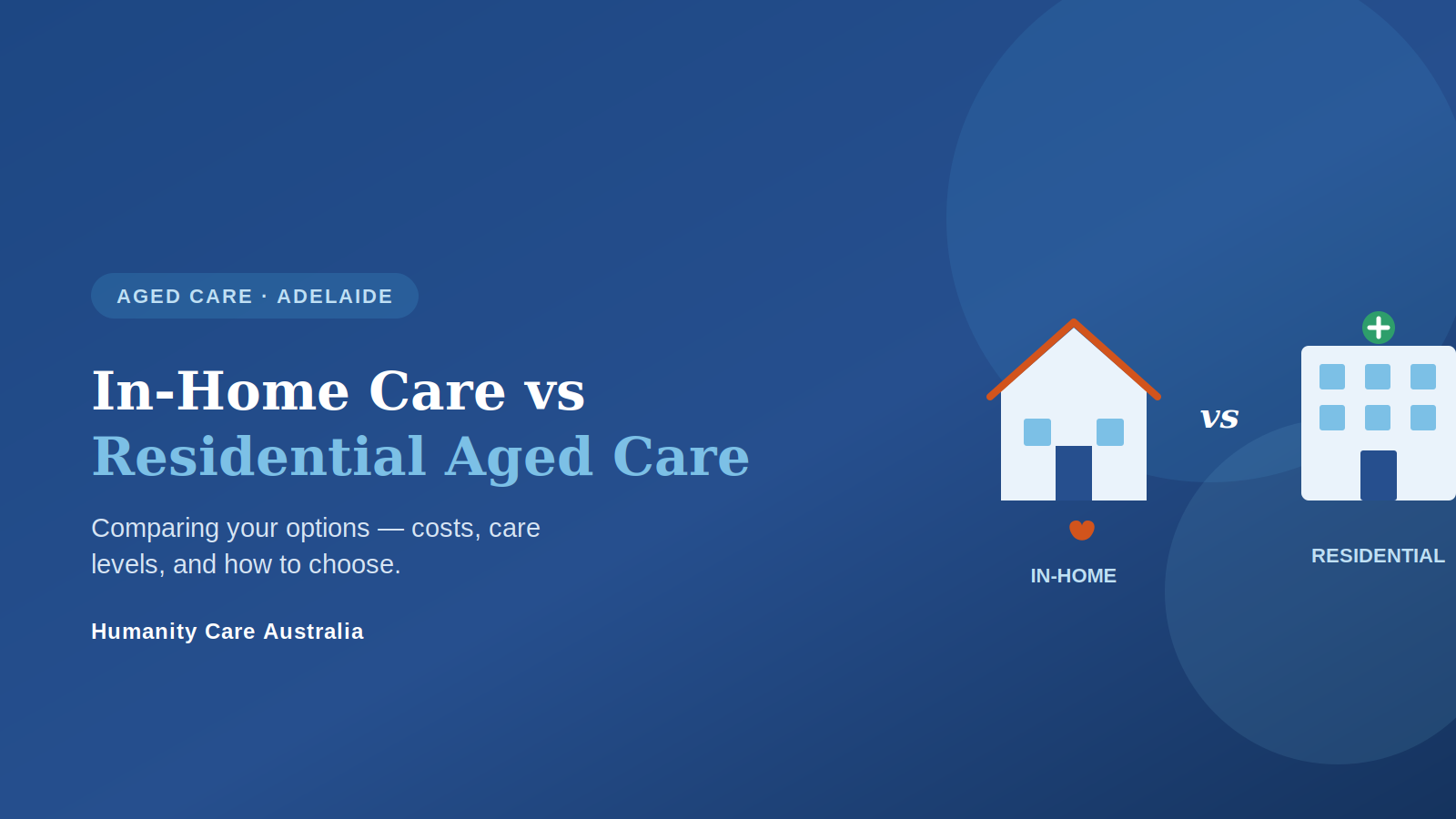
One of the biggest decisions families face as a loved one ages is this: should they stay at home with support, or move into residential aged care? There’s no single right answer — it depends on care needs, wishes, home suitability and finances. This guide compares in-home care and residential aged care in Adelaide, so you can weigh up what’s right for your situation.
- In-home care lets you stay in your own home with support — now delivered through Support at Home.
- Residential aged care provides 24/7 care and accommodation in an aged care home.
- Both are government-subsidised and means-tested — what you pay depends on your income and assets.
- Access to both starts the same way — with an assessment through My Aged Care.
What is in-home aged care?
In-home aged care lets an older person stay living in their own home while receiving support with daily life. This might include help with personal care, meals, cleaning, transport, and social connection — as much or as little as needed. It’s now mostly delivered through the government’s Support at Home program, which replaced Home Care Packages in late 2025, with different funding levels based on assessed needs.
For many older Australians, staying home is the preferred option — it keeps them in familiar surroundings, close to their community, and in control of their routine. See our guide to in-home aged care in Adelaide for more.
What is residential aged care?
Residential aged care means moving into an aged care home, where you live and receive support around the clock. It provides accommodation, meals, personal and clinical care, and 24/7 staffing — including registered nurses. It’s designed for people whose needs are higher or more complex than can be safely met at home, or who need more support than in-home care can practically provide.
In-home care vs residential aged care: side by side
| In-home care | Residential aged care | |
|---|---|---|
| Where you live | Your own home | An aged care home |
| Level of care | Scheduled support, as needed | 24/7 care and supervision |
| Best for | Lower to moderate needs | Higher or complex needs |
| Delivered through | Support at Home | Residential aged care facilities |
| Accommodation cost | None (you’re in your own home) | Yes (room payment) |
The benefits of each option
In-home care: staying put
Familiar surroundings, independence, community connection, and often lower out-of-pocket costs (no accommodation payment). Ideal when needs can be safely met at home.
Residential care: full support
Round-the-clock care, on-site nursing, meals and cleaning taken care of, and social community. Ideal when needs are high, complex, or care at home is no longer safe.
How much does each cost?
Both in-home and residential aged care are heavily subsidised by the government, and both are means-tested — what you pay depends on your income and assets. In broad terms:
- In-home care (Support at Home) generally has no accommodation cost (you’re in your own home), and your contributions depend on your assessed level and the type of service. Clinical care like nursing is fully government-funded.
- Residential aged care involves a basic daily fee, an accommodation payment (often a lump sum or a daily equivalent), and means-tested care contributions.
Because of the accommodation cost, residential care is usually more expensive out of pocket than in-home care for people with similar needs — though everyone’s situation is different.
Aged care fees are indexed twice a year and depend heavily on your personal means assessment, so exact figures date quickly. For an accurate picture of your likely costs, use the fee estimator on the My Aged Care website and get a means assessment through Services Australia. Independent financial advice is also worthwhile before making a decision.
Not sure which option is right?
Our Adelaide team can help you understand in-home and residential aged care, and what would suit your loved one’s needs — with no pressure.
How do you access aged care?
Whichever option you’re considering, the pathway starts the same way — with an assessment:
1. Contact My Aged Care
Call My Aged Care on 1800 200 422 (or apply online) to register and request an assessment.
2. Have an assessment
A qualified assessor visits (usually at home) to understand needs and determine what care you’re eligible for.
3. Get a means assessment
Services Australia assesses your income and assets to work out your contributions.
4. Choose a provider
Once approved, choose a provider that suits your needs, whether for in-home or residential care.
How to decide what’s right
There’s no universal answer — but a few questions help guide the decision:
- How high are the care needs? Lower to moderate needs often suit in-home care; high or complex needs may need residential.
- Is the home suitable and safe? Consider accessibility, falls risk, and whether it can be adapted.
- What does your loved one want? Staying home matters enormously to many people — their wishes should be central.
- What informal support is available? Family and community support can make staying home more viable.
- What are the finances? A means assessment and financial advice will clarify the real costs of each path.
Many people start with in-home care and move to residential care later as needs change. Others use residential respite to trial the setting. The right choice today isn’t locked in forever — you can reassess as circumstances change.
Humanity Care is an aged care specialist in Adelaide, offering flexible in-home support and residential care options. We take the time to understand each person’s needs and wishes, and help families navigate the choice with compassion and clarity.
Frequently asked questions about in-home vs residential aged care
Is in-home care cheaper than residential aged care?
Usually, yes — for people with similar needs. In-home care has no accommodation cost because you stay in your own home, whereas residential care involves a room payment on top of daily fees. However, both are means-tested, so exact costs depend on your income and assets. A means assessment gives you accurate figures.
What is Support at Home?
Support at Home is the government program for in-home aged care that replaced Home Care Packages in late 2025. It provides funding across different levels based on assessed needs, covering services like personal care, help around the home, and clinical care (which is fully government-funded).
When is residential aged care the better option?
Residential care tends to suit people whose needs are higher or more complex than can be safely met at home, who need 24/7 support and on-site nursing, or where care at home is no longer practical or safe. It provides accommodation, meals, and round-the-clock care in one place.
How do I access aged care?
Start by contacting My Aged Care on 1800 200 422 to register and request an assessment. A qualified assessor determines what care you’re eligible for, and Services Australia assesses your means to work out contributions. Once approved, you choose a provider for in-home or residential care.
Can I switch from in-home care to residential care later?
Yes. Many people start with in-home care and move to residential care as their needs increase — it’s a common path. Your care can be reassessed as circumstances change, and residential respite can be a way to trial the setting before making a permanent move.
Does Humanity Care offer both in-home and residential aged care?
Yes. Humanity Care is an aged care specialist in Adelaide offering flexible in-home support and residential care options. We help families understand the choices and find the right fit for their loved one. Get in touch for a no-obligation chat.
The right choice is personal
In-home care and residential aged care each have real strengths — and the best choice comes down to care needs, wishes, home suitability and finances. Understanding both options, getting a proper assessment, and seeking financial advice will help you make a decision you feel confident about.
If you’d like help weighing up aged care options in Adelaide, our friendly local team is here for a no-obligation chat.
Explore aged care options in Adelaide
Talk to our local team about in-home and residential aged care — and we’ll help you find the right fit, with no obligation.