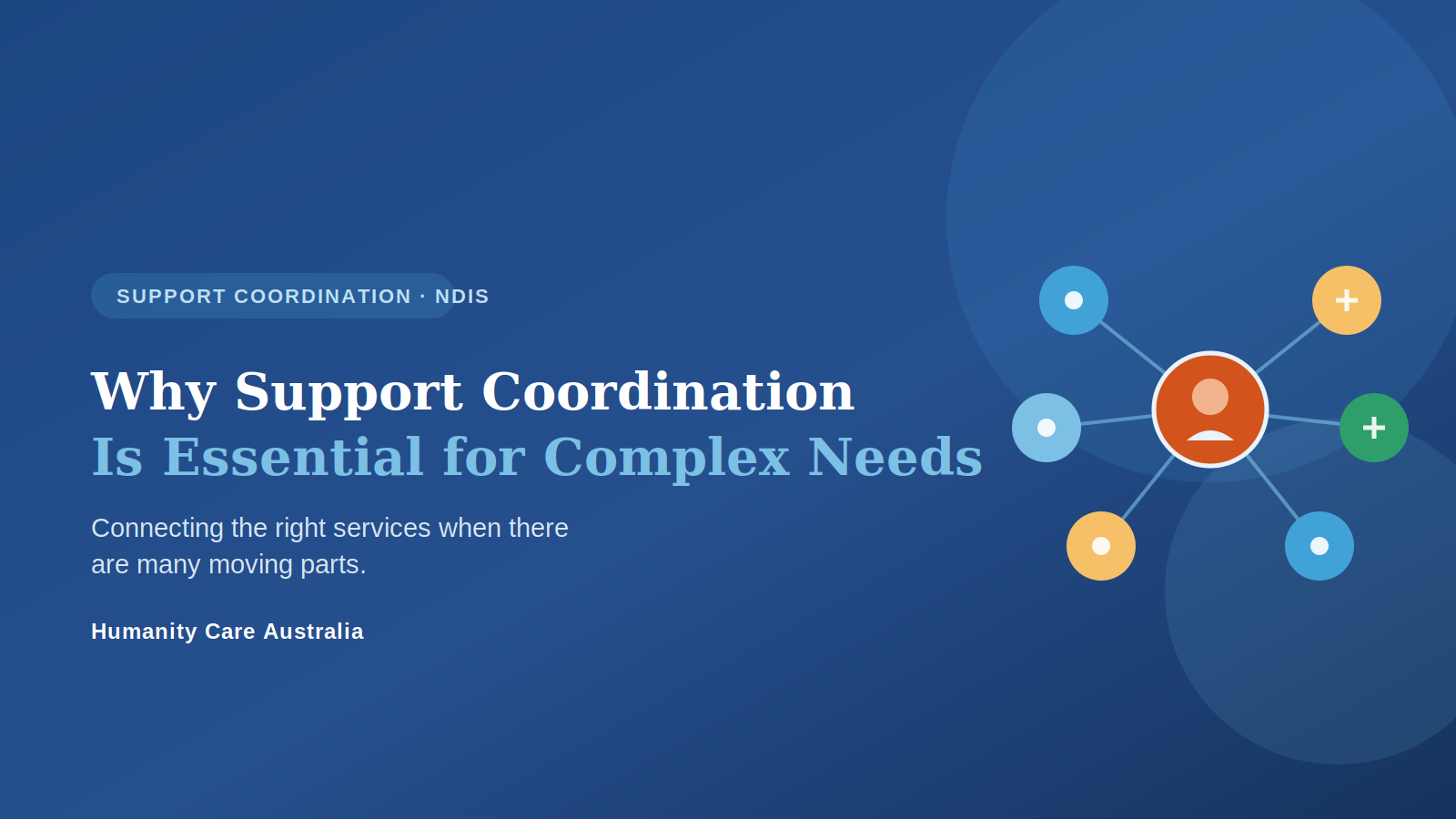
When someone’s situation is straightforward, navigating the NDIS can be manageable. But when needs are complex — multiple health conditions, several providers, high support requirements, or a crisis to manage — things get complicated fast. That’s exactly where support coordination proves its worth. This guide explains why support coordination is so valuable for people with complex care needs, and what a good coordinator actually does.
- Complexity creates coordination challenges — multiple providers and needs are hard to juggle alone.
- A support coordinator ties it all together — connecting services and making the plan work.
- Specialist coordination exists for high complexity — an even higher level of support.
- It reduces stress and improves outcomes — for the participant and their family.
What “complex care needs” really means
Complex care needs can take many forms. It might be someone with multiple disabilities or health conditions, someone who needs support from several different providers at once, a person whose situation involves significant risk or is unstable, or someone navigating a crisis or major life transition. In these situations, an NDIS plan can involve a lot of moving parts — and keeping them all working together is a genuine challenge.
For a participant or family trying to manage this alone, it can quickly become overwhelming. Appointments, providers, plans, budgets, communication — the sheer coordination load is exhausting, and things can fall through the cracks.
Think of an orchestra. Each provider is a talented musician, but without a conductor, they can’t play in harmony. A support coordinator is that conductor — making sure every part of a person’s support works together, in time, towards the same goal. The more instruments involved, the more essential the conductor becomes.
What a support coordinator does for complex needs
A support coordinator takes on the coordination load, so the participant and family don’t have to. For complex situations, that includes:
Connecting the right services
Finding and linking the mix of providers a person needs — and making sure they work together, not in silos.
Managing multiple relationships
Being the central point of contact, so providers communicate and coordinate rather than working in isolation.
Navigating challenges
Problem-solving when things go wrong, managing risk, and responding when circumstances change quickly.
Building capacity
Helping the participant and family develop the skills and confidence to manage more over time.
Specialist Support Coordination: for the highest complexity
The NDIS recognises that some situations need an even higher level of support. For these, there’s Specialist Support Coordination (sometimes called Level 3) — a more intensive form of coordination, delivered by practitioners with specialist expertise, for participants whose situations are especially complex or involve significant risk.
A specialist support coordinator does everything a regular coordinator does, but with the added skill to manage high-risk, high-complexity situations — reducing barriers, addressing challenges in the support environment, and helping stabilise things so the person can move forward.
The NDIS funds support connection at different levels: Support Connection (helping you understand and use your plan), Coordination of Supports (the most common level, coordinating your services), and Specialist Support Coordination (for high-complexity situations). The right level depends on your needs — and it’s set out in your plan.
Managing complex needs?
Our Adelaide support coordinators are experienced in complex situations — connecting services, managing multiple providers, and taking the coordination load off you and your family.
Why it matters: the real benefits
For people with complex needs, good support coordination isn’t a luxury — it’s often what makes the whole plan work. The benefits are significant:
- Less stress — the coordination burden shifts from the family to a professional.
- Better outcomes — services that work together deliver more than services working in isolation.
- Fewer things falling through the cracks — someone is watching the whole picture.
- Faster crisis response — a coordinator can act quickly when things change.
- More value from the plan — funding is used effectively towards the person’s goals.
- Peace of mind — knowing there’s an expert helping steer the ship.
When someone has complex needs, family members often become unofficial coordinators — chasing appointments, managing providers, and carrying enormous stress. A good support coordinator lifts that weight, letting families step back into their role as family, rather than case managers.
Humanity Care provides experienced support coordination across Adelaide, including for participants with complex needs. We connect the right services, keep providers working together, respond when things change, and build capacity — so your plan works as hard as it can for you.
Frequently asked questions about support coordination for complex needs
Why is support coordination important for complex needs?
Complex needs usually mean multiple providers, conditions and moving parts — which are hard to juggle alone. A support coordinator ties it all together: connecting the right services, keeping providers working in harmony, managing challenges, and taking the coordination load off the participant and family. It often makes the difference in whether a plan actually works.
What is Specialist Support Coordination?
Specialist Support Coordination (sometimes called Level 3) is a more intensive form of coordination for participants with especially complex situations or significant risk. Delivered by practitioners with specialist expertise, it does everything regular coordination does, plus managing high-risk, high-complexity situations and helping stabilise things.
What are the levels of support coordination?
There are three: Support Connection (helping you understand and use your plan), Coordination of Supports (the most common level, coordinating your services and building your capacity), and Specialist Support Coordination (for high-complexity situations). The level you’re funded for depends on your needs and is set out in your plan.
How does support coordination help families?
When someone has complex needs, family members often become unofficial coordinators, carrying enormous stress. A support coordinator takes on that load — managing providers, appointments and the plan — letting families step back into their role as family rather than case managers. It’s a genuine relief for many households.
How do I get support coordination in my plan?
Support coordination is funded under Capacity Building in your NDIS plan. If your situation is complex, it’s worth raising this at your planning meeting and providing evidence of your needs. A higher or specialist level of coordination requires demonstrating the complexity or risk involved. Your planner or LAC can help.
Does Humanity Care provide support coordination for complex needs?
Yes. Humanity Care provides experienced support coordination across Adelaide, including for participants with complex needs. We connect services, manage multiple providers, respond to changing circumstances, and build capacity. Get in touch for a no-obligation chat about how we can help.
Complexity handled with care
The more complex a person’s needs, the more valuable good support coordination becomes. A skilled coordinator turns a tangle of providers, appointments and challenges into a coherent, working plan — reducing stress, improving outcomes, and giving families back their peace of mind. For complex situations, it’s one of the most important supports the NDIS offers.
If you or a loved one has complex needs and could use experienced support coordination in Adelaide, our friendly local team is here to help.
Get experienced support coordination in Adelaide
Talk to our local team about support coordination for complex needs — connecting your services and easing the load, with no obligation.