Support coordinator. Plan manager. Two roles that sound similar, often get muddled, and leave a lot of NDIS participants genuinely confused about who does what. The good news: once you understand the difference, it’s simple — and you can have both, working side by side. This guide explains exactly what each one does, how they differ, and how to decide what you need.
- A support coordinator handles your supports — connecting you with providers and helping you use your plan.
- A plan manager handles your money — paying invoices, tracking your budget and keeping financial records.
- They’re not the same, and you can have both — they do different jobs and work well together.
- Both are funded separately — neither reduces the funding available for your other supports.
The difference in one line
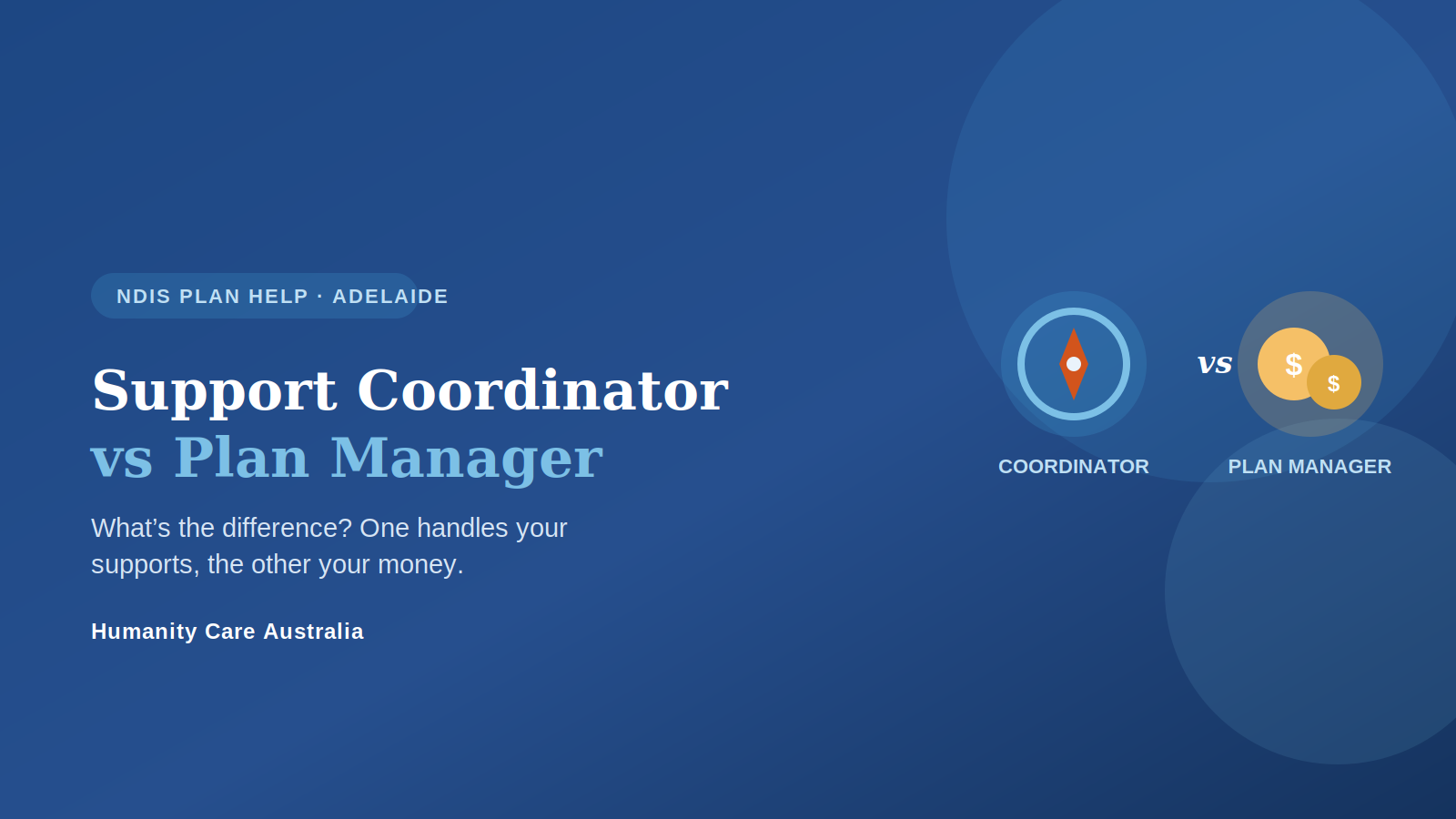
Here’s the simplest way to remember it: a support coordinator helps with your supports; a plan manager helps with your money. One is your navigator, the other is your bookkeeper. They’re two different jobs, funded separately, and many participants use both at once.
Think of building a house. A support coordinator is like the person who helps you find the right tradespeople, coordinate them, and make sure the work meets your goals. A plan manager is like the bookkeeper who pays the invoices and keeps the accounts straight. Both are useful, and they do completely different things.
What does a support coordinator do?
A support coordinator helps you use your NDIS plan. They look at the whole picture of your life and goals, and help you turn your plan into real support. Their role includes:
- Helping you understand your plan and what your funding can be used for
- Researching and connecting you with the right providers and community supports
- Coordinating your supports so they work together
- Solving problems when things don’t go to plan, and helping in a crisis
- Building your confidence and skills to manage your own supports over time
Crucially, a support coordinator focuses on the supports themselves — not the money. For a deeper look, see our guide to what a support coordinator is and how they help.
What does a plan manager do?
A plan manager handles the financial side of your NDIS plan. They’re a registered provider who takes the admin and paperwork off your plate. Their role includes:
- Receiving and checking invoices from your providers
- Paying those invoices from your NDIS funding, so you’re not out of pocket
- Tracking your budget and helping you avoid over- or under-spending
- Keeping your financial records and providing reporting
- Giving you the flexibility to use both registered and non-registered providers
A plan manager doesn’t choose your supports or coordinate your services — they make sure the money side runs smoothly, so you keep choice and control without the paperwork burden.
Not sure what you need?
Our Adelaide team can help you understand your plan and whether support coordination is right for you — and point you in the right direction for plan management. No pressure, just clarity.
Support coordinator vs plan manager: side by side
| Support coordinator | Plan manager | |
|---|---|---|
| Focus | Your supports | Your money |
| Main job | Connect and coordinate services | Pay invoices and track budgets |
| Handles providers? | Finds and coordinates them | Pays them |
| Handles money? | No | Yes |
| Think of them as | Your navigator | Your bookkeeper |
Where plan management fits: your three options
Plan management is actually one of three ways your NDIS funding can be managed. It helps to see all three:
Self-managed
You handle everything — paying providers, claiming from the NDIS, and keeping records. Maximum control, maximum admin.
Plan-managed
A plan manager handles the money side for you, while you keep choice and control over your supports — including non-registered providers.
Agency-managed (NDIA)
The NDIA pays your providers directly. The simplest option, but you can generally only use NDIS-registered providers.
You can even combine these across different parts of your plan. And you can change how your plan is managed — you don’t have to wait for a new plan.
Here’s a key point: support coordination is separate from how your plan is managed. You can have a support coordinator whether you’re self-managed, plan-managed or agency-managed. The two questions — “who helps me use my supports?” and “who handles the money?” — are answered independently.
Do you need one, the other, or both?
It depends on your situation. As a rough guide:
You might want a support coordinator if…
Your situation is complex, you’re new to the NDIS, you’re juggling multiple providers, or you need help turning your plan into action.
You might want a plan manager if…
You want the flexibility to use any provider without the stress of paying invoices, claiming, and keeping financial records yourself.
Many participants have both — a support coordinator to help them find and coordinate quality supports, and a plan manager to handle the invoices behind the scenes. Both types of funding are added to your plan separately and don’t reduce your other supports.
Humanity Care provides person-centred support coordination across Adelaide — helping you understand your plan, connect with quality providers, and build your confidence to direct your own supports. If you also need plan management, we can help point you in the right direction. Our focus is making your plan genuinely work for you.
Frequently asked questions about support coordinators and plan managers
What’s the difference between a support coordinator and a plan manager?
A support coordinator helps with your supports — connecting you with providers and coordinating your services. A plan manager helps with your money — paying invoices, tracking your budget and keeping financial records. One is your navigator, the other is your bookkeeper. They do different jobs and you can have both.
Can I have both a support coordinator and a plan manager?
Yes, and many participants do. A support coordinator helps you find and coordinate quality supports, while a plan manager handles the invoices behind the scenes. Both are funded separately in your plan and don’t reduce your other supports, so having both doesn’t cost you funding elsewhere.
Does a plan manager choose my providers?
No. A plan manager handles the financial side — paying invoices and tracking your budget — but you keep full choice and control over which providers you use. In fact, plan management lets you use both registered and non-registered providers, giving you more flexibility.
Does having a support coordinator or plan manager cost me funding?
Both support coordination and plan management are funded as separate allocations in your NDIS plan. They don’t come out of your other support budgets, so using them doesn’t reduce the funding available for your day-to-day supports.
Can I change how my plan is managed?
Yes. You can request to change how your funding is managed — between self-managed, plan-managed and agency-managed — and you don’t always have to wait for a new plan. Many people start agency-managed and move to plan-managed as they gain confidence. Talk to your NDIA contact about making a change.
Does Humanity Care provide support coordination in Adelaide?
Yes. Humanity Care provides person-centred support coordination across Adelaide, helping you understand your plan, connect with quality providers, and get the most from your funding. If you also need plan management, we can point you in the right direction. Get in touch for a no-obligation chat.
Two roles, one goal
Support coordinators and plan managers do different jobs, but they share a purpose: helping you get the most from your NDIS plan with less stress. Understanding who does what is the first step to building the right team around you — whether that’s one of them, the other, or both working together.
If you’d like help working out what you need, our friendly Adelaide team is here for a no-obligation chat.
Get clarity on your NDIS plan in Adelaide
Talk to our local team about support coordination and how to get the most from your plan — with no obligation.