If your NDIS plan is a toolkit, Core Supports is the part you’ll reach for almost every day. It’s the most flexible — and usually the largest — part of your plan, covering the everyday support that helps you live your life. But that flexibility can also make it confusing. This guide explains what NDIS Core Supports are, the four categories, what you can (and can’t) spend the funding on, and how to make it work for you.
- Core Supports is the most flexible budget — often 60–70% of a plan, for everyday disability-related needs.
- There are four categories — Assistance with Daily Life, Social & Community Participation, Consumables, and Transport.
- You can usually move funds between categories — without a plan review — with some exceptions like Transport.
- It’s for disability-related supports only — not rent, groceries or entertainment.
What are NDIS Core Supports?
Your NDIS plan is divided into three main budgets: Core Supports, Capacity Building, and Capital. Core Supports is the budget that helps you with everyday activities and your current disability-related needs. It’s typically the largest part of a plan, and the most flexible — designed to help you live as independently as possible, day to day.
Where Capacity Building is about building skills for the future, Core Supports is about your needs right now — the practical, everyday help that keeps life running.
Core Supports is the most flexible part of your plan. In most cases you can move funding between categories as your needs change — without needing a plan review. If you need less help with personal care this month but more support to get out into the community, you can usually shift funds across. This flexibility is Core Supports’ greatest strength.
The four Core Support categories
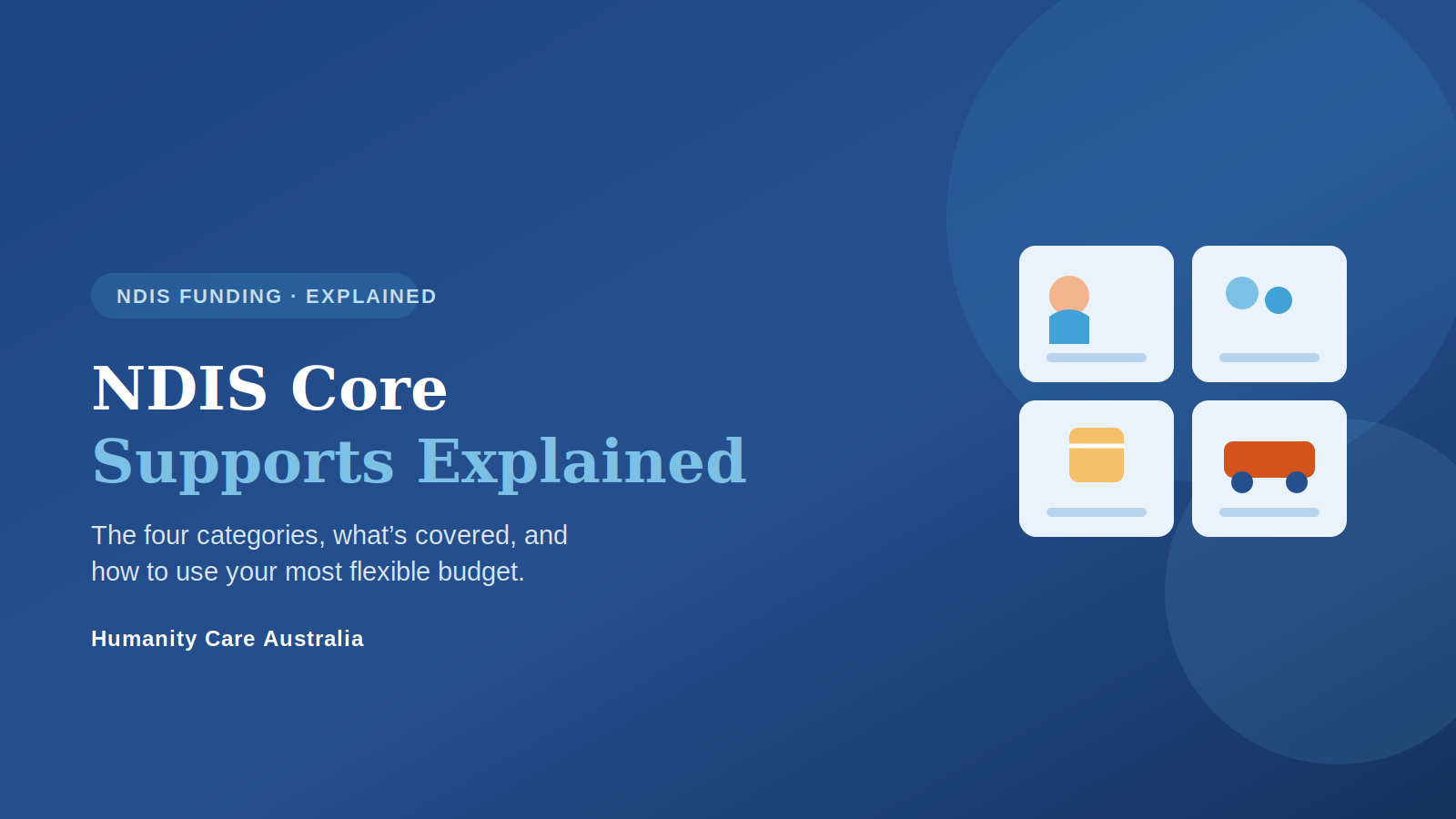
Core Supports is made up of four categories. Here’s what each one covers.
Assistance with Daily Life
Support workers who help with everyday tasks — personal care, meal preparation, household tasks and in-home support.
Assistance with Social & Community Participation
Support to take part in social, recreational and community activities — from group programs to one-on-one support.
Consumables
Everyday disability-related items — such as continence products, low-cost assistive technology and some nutritional supplies.
Transport
Support to get to appointments, work, education or the community — though transport funding often works a little differently (see below).
How flexible is Core Supports funding, really?
This is where people get tripped up, so it’s worth being precise. In most cases, you can move funding freely between Assistance with Daily Life, Consumables, and Social & Community Participation — as long as they’re managed the same way — without a plan review.
The main exception is Transport. Transport funding is often a “stated” support — particularly if you receive it as a periodic (fortnightly) payment — which means it can be fixed to travel-related use and not moved freely across the other categories. Some other supports are also “stated,” meaning they must be used exactly as set out in your plan.
Core Supports funding must be for disability-related supports only. It can’t be used for everyday living costs like rent, groceries or entertainment. And you can’t move Core funding into your Capacity Building or Capital budgets — those are locked to their own purposes. Core flexibility only works within Core.
Want help using your Core Supports?
Our Adelaide team provides a range of Core Support services — from daily living help to community participation — built around your goals. Let’s talk about what would help most.
What can you actually spend Core Supports on?
Because it’s flexible, Core Supports covers a wide range of everyday supports. Common examples include:
- A support worker to help with showering, dressing and personal care
- Help with cleaning, laundry, cooking and other household tasks
- Support to attend social events, community activities or group programs
- Everyday consumable items related to your disability
- Transport support to get to appointments and out into your community
- In some cases, home and living supports (which sit within their own part of Core)
Everyone uses their Core Supports differently — the key is that the support is reasonable and necessary, related to your disability, and in line with your plan and goals.
Tips for making the most of your Core Supports
Use the flexibility
Shift funds between categories as your needs change through the year — that’s what the flexibility is for.
Track your spending
Core funding doesn’t roll over to your next plan, so keep an eye on your budget to avoid running out early or leaving funds unused.
Know what’s “stated”
Check which parts of your Core budget are flexible and which are fixed (like some transport), so you plan correctly.
Get support if you need it
A support coordinator or plan manager can help you use your Core budget well.
Since 2025, the NDIS has released plan funding in funding periods (often quarterly) rather than all at once. This means your funding becomes available gradually across your plan. It’s worth keeping in mind when planning your spending, so you don’t expect the full amount to be accessible from day one.
Humanity Care provides a full range of Core Support services across Adelaide — personal care, household tasks, community participation and more — delivered by trained, screened workers who focus on your goals. We’re happy to help you understand how your Core budget can support the life you want.
Frequently asked questions about NDIS Core Supports
What are the four Core Support categories?
The four categories are Assistance with Daily Life, Assistance with Social & Community Participation, Consumables, and Transport. Together they cover the everyday, disability-related support that helps you live independently. Core Supports is usually the largest and most flexible part of your NDIS plan.
Can I move money between Core Support categories?
In most cases, yes — you can move funding between Assistance with Daily Life, Consumables, and Social & Community Participation without a plan review, as long as they’re managed the same way. Transport is the main exception, as it’s often a “stated” support fixed to travel-related use.
What can’t Core Supports be used for?
Core Supports must be for disability-related supports only. It can’t be used for everyday living costs like rent, groceries or entertainment. You also can’t move Core funding into your Capacity Building or Capital budgets — those are locked to their own purposes.
Is Transport part of Core Supports?
Yes, Transport is one of the four Core Support categories. However, it often works differently to the others — if you receive transport funding as a periodic (fortnightly) payment, it’s usually fixed to travel-related use and can’t be moved flexibly across the other Core categories.
Does unused Core Supports funding roll over?
No. Core Supports funding is for the duration of your plan (typically 12 months) and doesn’t roll over to your next plan. It’s worth tracking your spending across the year so you use your budget effectively — without running out early or leaving funding unused.
Can Humanity Care provide Core Support services in Adelaide?
Yes. Humanity Care provides a range of Core Support services across Adelaide — including personal care, household tasks and community participation — delivered by trained, screened workers. Get in touch for a no-obligation chat about how we can support you.
The everyday backbone of your plan
Core Supports is the part of your NDIS plan you’ll use most — the everyday help that keeps life moving and supports your independence. Understanding the four categories, using the flexibility wisely, and keeping an eye on your budget will help you get the most from it.
If you’d like help understanding or using your Core Supports in Adelaide, our friendly local team is here for a no-obligation chat.
Get the most from your Core Supports in Adelaide
Talk to our local team about the everyday support that would help you most — and we’ll help you make your plan work for you.