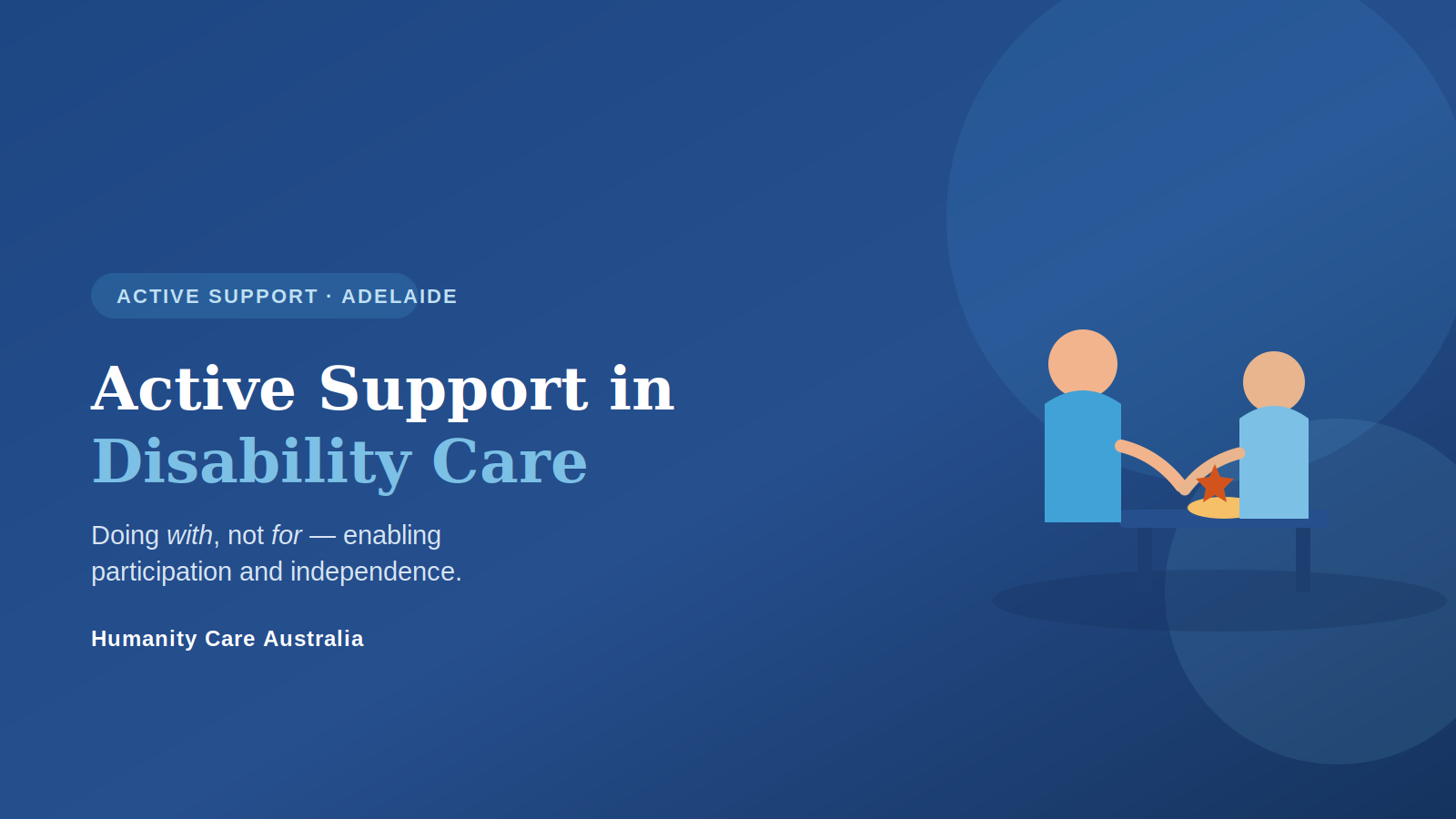
There’s a quiet but powerful shift in how good disability support is delivered — away from doing things for people, and towards doing things with them. That shift has a name: active support. It’s an approach that turns everyday moments into opportunities for participation, independence and growth. This guide explains what active support is, how it works, and why it makes such a difference.
- Active support means doing with, not for — supporting people to participate, rather than taking over.
- Every moment has potential — ordinary daily tasks become chances to engage and build skills.
- Support is graded to the person — just enough help to enable success, no more.
- It builds independence and wellbeing — participation improves confidence, skills and quality of life.
What is active support?
Active support is a person-centred way of providing support that enables people with disability to participate in their own lives — in everyday activities, in their home, and in their community — regardless of their level of ability. Instead of a support worker doing a task for someone, active support is about doing it with them, breaking it down so they can take part in whatever way they can.
It’s grounded in a simple but profound belief: everyone can participate, and everyone benefits from doing so. The support worker’s job isn’t to complete tasks efficiently on the person’s behalf — it’s to enable the person to be genuinely involved.
Making a cup of tea. The “doing for” approach: the support worker makes it and hands it over. The active support approach: they support the person to take part — maybe filling the kettle, choosing the mug, adding the milk — with just enough help to succeed. The person isn’t a passive recipient; they’re an active participant. That small shift, repeated across a day, changes everything.
The core principles of active support
Active support rests on a few key ideas that work together:
Every moment has potential
Ordinary daily activities — cooking, cleaning, shopping — are opportunities to participate and learn, not just tasks to get done.
Little and often
Frequent, small opportunities to engage throughout the day add up to meaningful participation over time.
Graded assistance
Support is matched to the person — just enough help to enable success, and no more, so the person does as much as they can.
Maximising choice & control
The person’s preferences drive the activity — they choose, they lead, and their voice guides the support.
Graded assistance: the heart of the approach
One of the most important active support skills is knowing how much help to give. Too much, and you take over — the person becomes a bystander. Too little, and they struggle and disengage. Active support uses graded assistance: offering the least intrusive support needed for the person to succeed, and adjusting as they grow.
Support might range from a simple verbal prompt, to showing or gesturing, to hands-on help — always starting with the least help necessary. As the person builds skill and confidence, the support gradually reduces.
Active support isn’t about a task being done perfectly or quickly. It’s about the person being genuinely involved. A meal that takes longer because the person helped prepare it is a success — even if it’s not how a support worker would have done it alone. The participation is the point.
Support that empowers
Our Adelaide team practises active support — enabling participation, building skills, and helping people take an active role in their own lives, at their own pace.
Why active support matters
The benefits of active support are significant and well-recognised in the disability sector:
- Greater independence — people build real skills by doing, not watching.
- Increased engagement — participation reduces boredom, disengagement and challenging behaviour.
- Improved wellbeing — being active and involved boosts confidence, mood and self-worth.
- More choice and control — people direct their own activities and lives.
- Dignity — being treated as a capable participant, not a passive recipient of care.
Research and practice consistently show that when support shifts from “doing for” to “doing with,” people’s engagement and quality of life improve — sometimes dramatically.
How active support connects to life skills
Active support and life skills training go hand in hand. Active support is the everyday method — the way support workers enable participation moment to moment. Life skills training is the goal that method builds towards: lasting independence. Every time a support worker uses active support to involve someone in a task, they’re helping build the skills and confidence that lead to a more independent life.
At Humanity Care, active support is part of how we work. Our Adelaide support workers are trained to enable participation, grade their assistance to each person, and turn everyday activities into opportunities for growth — always doing with, not for. It’s support that respects each person’s capability and potential.
Frequently asked questions about active support
What is active support in disability care?
Active support is a person-centred approach that enables people with disability to participate in everyday activities, rather than having things done for them. Instead of a support worker completing a task on the person’s behalf, they support the person to take part — doing “with, not for” — with just enough help to succeed.
What are the principles of active support?
The core principles are: every moment has potential (ordinary tasks are chances to participate); little and often (frequent small opportunities to engage); graded assistance (just enough help to succeed, no more); and maximising choice and control (the person leads). Together they enable genuine participation regardless of ability level.
What is graded assistance?
Graded assistance means offering the least intrusive support a person needs to succeed at a task — and no more. It might range from a verbal prompt, to a gesture or demonstration, to hands-on help, always starting with the least. As the person builds skill and confidence, the level of support gradually reduces.
How is active support different from regular care?
Traditional care often focuses on doing tasks for a person efficiently. Active support focuses on enabling the person to participate in those tasks themselves, at whatever level they can. The shift from “doing for” to “doing with” transforms the person from a passive recipient into an active participant, building skills and confidence.
Does active support work for people with high support needs?
Yes. A key principle of active support is that everyone can participate, regardless of their level of ability — the support is simply adapted. Even someone with very high support needs can be involved in a task in some way, and that participation has real value for engagement, wellbeing and dignity.
Does Humanity Care use active support?
Yes. Active support is part of how Humanity Care works across Adelaide. Our support workers are trained to enable participation, grade their assistance to each person, and turn everyday activities into opportunities for growth. Get in touch for a no-obligation chat about our approach.
Support that sees potential
Active support is more than a technique — it’s a mindset that sees the capability and potential in every person. By doing with rather than for, it turns everyday life into a source of participation, skill-building and dignity. It’s one of the most respectful and empowering ways to provide support.
If you’d like support in Adelaide that genuinely empowers — enabling participation and building independence — our friendly local team is here to help.
Experience active support in Adelaide
Talk to our local team about person-centred support that enables participation and builds independence — with no obligation.