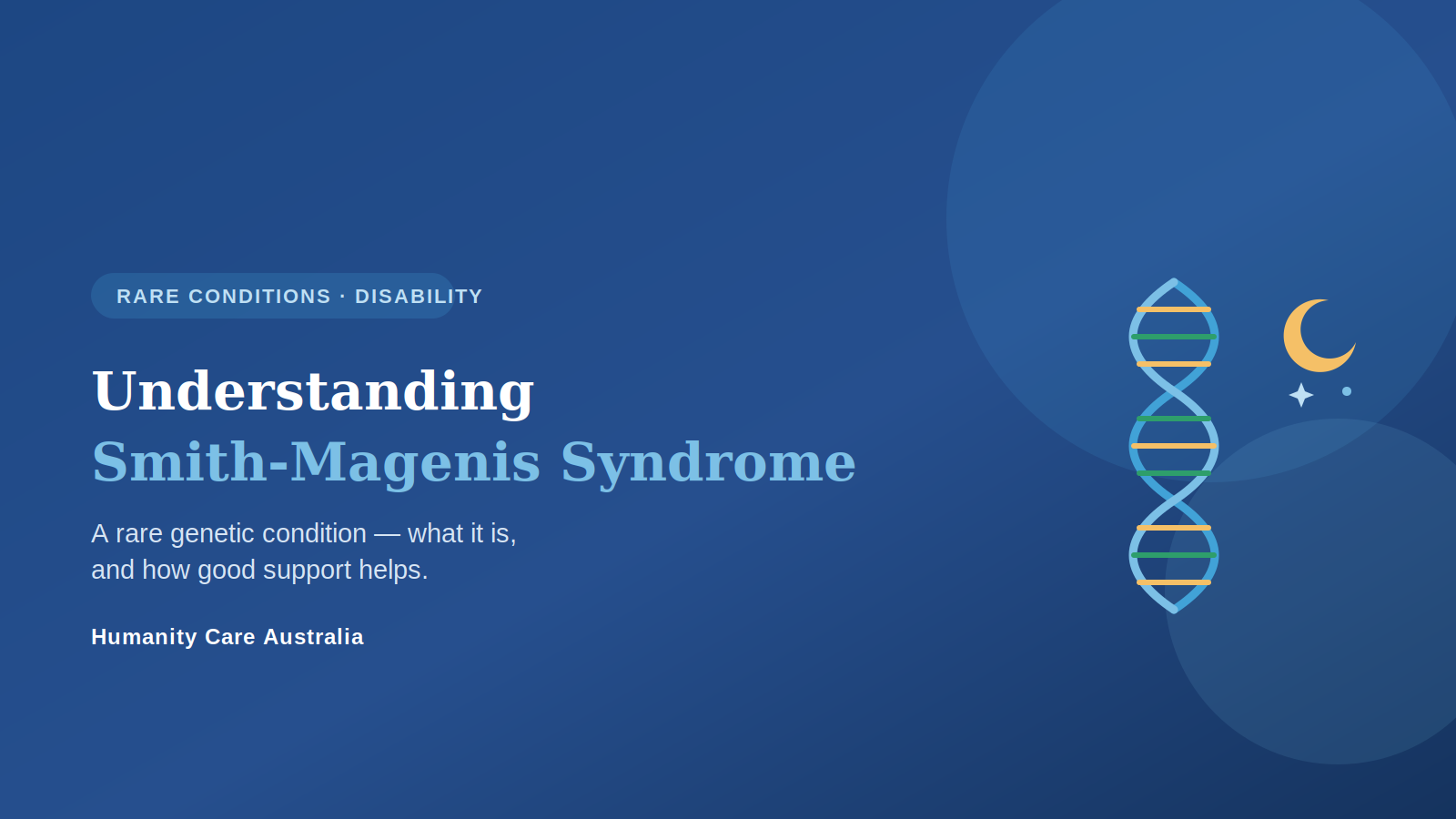
Smith-Magenis syndrome (SMS) is a rare genetic condition that many people — even within the disability sector — have never heard of. Yet for the families living with it, understanding and support make an enormous difference. This guide offers a clear, respectful overview of Smith-Magenis syndrome: what it is, what causes it, its characteristics, and how good support helps people with SMS and their families live well.
- SMS is a rare genetic condition — affecting around 1 in 25,000 people.
- It’s caused by a change on chromosome 17 — and is usually not inherited.
- Sleep and behaviour are key features — alongside developmental and intellectual differences.
- Support focuses on quality of life — there’s no cure, but the right support helps enormously.
What is Smith-Magenis syndrome?
Smith-Magenis syndrome is a rare genetic neurodevelopmental condition that affects several parts of the body and development. It’s estimated to affect around 1 in 25,000 people. SMS is characterised by a particular pattern of features — including developmental delay, intellectual disability (usually in the mild-to-moderate range), distinctive facial features, and notably, characteristic sleep and behavioural differences.
Like any condition, SMS affects each person differently, and every individual with SMS is exactly that — an individual, with their own personality, strengths and needs. Notably, people with SMS are often described as having affectionate, engaging personalities, which shines through alongside the challenges.
As with any diagnosis, it’s important to see the whole person, not a list of features. A child or adult with SMS is a unique individual first — the syndrome is one part of who they are, not the sum of it. Good support starts by getting to know the person: their personality, what they love, and what helps them thrive.
What causes Smith-Magenis syndrome?
SMS is genetic. In about 90% of cases, it’s caused by the deletion of a small piece of genetic material from a specific region of chromosome 17 (known as 17p11.2). In the remaining cases, it’s caused by a change in a particular gene within that region, called RAI1, which is thought to underlie most of the condition’s features.
In the great majority of cases, SMS is not inherited. The genetic change typically happens randomly during the formation of egg or sperm cells, or in early development — and most families have no history of the condition. This is important for parents to hear: SMS is not caused by anything you did or didn’t do. It’s a random genetic event, and nobody is to blame.
Characteristics of Smith-Magenis syndrome
SMS involves a range of characteristics, which vary widely in how they present from person to person. They can include:
Developmental & intellectual
Developmental delay and intellectual disability, usually in the mild-to-moderate range, and often delayed speech and language.
Sleep differences
A characteristic sleep pattern — difficulty falling and staying asleep, and daytime sleepiness — linked to disrupted body-clock rhythms.
Behavioural characteristics
Behavioural differences that can include self-injurious or attention-seeking behaviours, which are ways of communicating needs.
Sensory & physical
Sensory sensitivities, distinctive facial features, and sometimes other physical or health differences.
Understanding sleep in SMS
One of the most defining — and challenging — features of SMS is its effect on sleep. Many people with SMS have a disrupted sleep-wake cycle, thought to be linked to how the condition affects the body’s internal clock (circadian rhythm). This can mean trouble falling asleep, frequent night waking, and sleepiness during the day.
Sleep difficulties affect the whole family, and managing them is often a key focus of support. Approaches like consistent routines, a calm sleep environment, and medical guidance can all help — and there’s growing understanding of how best to support sleep in SMS. Families don’t have to navigate this alone.
Understanding behaviour in SMS
Behavioural differences are a recognised part of SMS, and can be one of the most demanding aspects for families. It’s important to understand that behaviours — including self-injurious ones — are almost always a form of communication: an expression of a need, discomfort, frustration or distress that the person can’t easily express another way.
Understanding behaviour as communication changes everything. Rather than simply trying to stop a behaviour, good support seeks to understand what it’s communicating — and to meet the underlying need. This is the foundation of positive, respectful behaviour support, which focuses on improving quality of life and building skills, not just managing behaviour.
Support for complex needs in Adelaide
Our Adelaide team provides person-centred support for people with complex needs — understanding each individual, supporting families, and focusing on quality of life.
Support and quality of life
There’s no cure for SMS, but that’s far from the whole story: with the right support, people with SMS can live full, happy lives, and families can be well supported too. Good support is holistic and person-centred, and often involves:
A multidisciplinary team
Doctors, therapists, and support workers working together around the person and family.
Positive behaviour support
Understanding behaviour, meeting underlying needs, building skills, and improving quality of life.
Sleep and routine support
Consistent routines and strategies to support better sleep for the person and family.
Family support
Practical help and respite so families can rest, recharge and keep supporting their loved one.
Families living with SMS often find great comfort and practical help in connecting with others who understand. Organisations like the Smith-Magenis Syndrome Foundation offer information, resources and community. And support providers, the NDIS (where eligible), and health professionals can all be part of a team around your family.
Humanity Care provides person-centred disability support across Adelaide, including for people with complex needs. We take time to understand each individual, work in partnership with families, and focus on quality of life — supporting people to thrive, and easing the load on those who care for them.
Frequently asked questions about Smith-Magenis syndrome
What is Smith-Magenis syndrome?
Smith-Magenis syndrome (SMS) is a rare genetic neurodevelopmental condition affecting around 1 in 25,000 people. It’s characterised by developmental delay, intellectual disability (usually mild-to-moderate), distinctive facial features, and notably characteristic sleep and behavioural differences. It affects each person differently, and people with SMS often have affectionate, engaging personalities.
What causes Smith-Magenis syndrome?
SMS is genetic. In about 90% of cases it’s caused by the deletion of a small piece of genetic material from chromosome 17 (region 17p11.2); the rest are caused by a change in the RAI1 gene. In the great majority of cases it’s not inherited — the change happens randomly, and most families have no history of the condition.
Is Smith-Magenis syndrome inherited?
Usually not. In the great majority of cases, the genetic change occurs randomly during the formation of egg or sperm cells or in early development, and most families have no history of SMS. It’s important for parents to know that SMS is not caused by anything they did — it’s a random genetic event, and no one is to blame.
Why do people with SMS have sleep problems?
Sleep difficulties are a defining feature of SMS, thought to be linked to how the condition affects the body’s internal clock (circadian rhythm). This can cause trouble falling and staying asleep, and daytime sleepiness. Consistent routines, a calm sleep environment and medical guidance can all help, and support is available for families navigating this.
How are behaviours in SMS best supported?
By understanding behaviour as communication — an expression of a need, discomfort or distress. Rather than just trying to stop a behaviour, good support seeks to understand what it’s communicating and meet the underlying need. This positive, respectful approach focuses on improving quality of life and building skills, and is best guided by professionals.
Can Humanity Care support someone with SMS?
Yes. Humanity Care provides person-centred disability support across Adelaide, including for people with complex needs. We take time to understand each individual, work in partnership with families, and focus on quality of life. Get in touch for a no-obligation chat about how we can support your family.
Understanding makes all the difference
Smith-Magenis syndrome brings real challenges — but with understanding, the right support, and connection with others who get it, people with SMS and their families can live full, meaningful lives. Every person with SMS is a unique individual, deserving of support that sees their strengths, meets their needs, and helps them thrive.
If you’re supporting a loved one with SMS or complex needs in Adelaide, our friendly local team is here to help.
Find person-centred support in Adelaide
Talk to our local team about support for complex needs, built around the individual and their family — with no obligation.