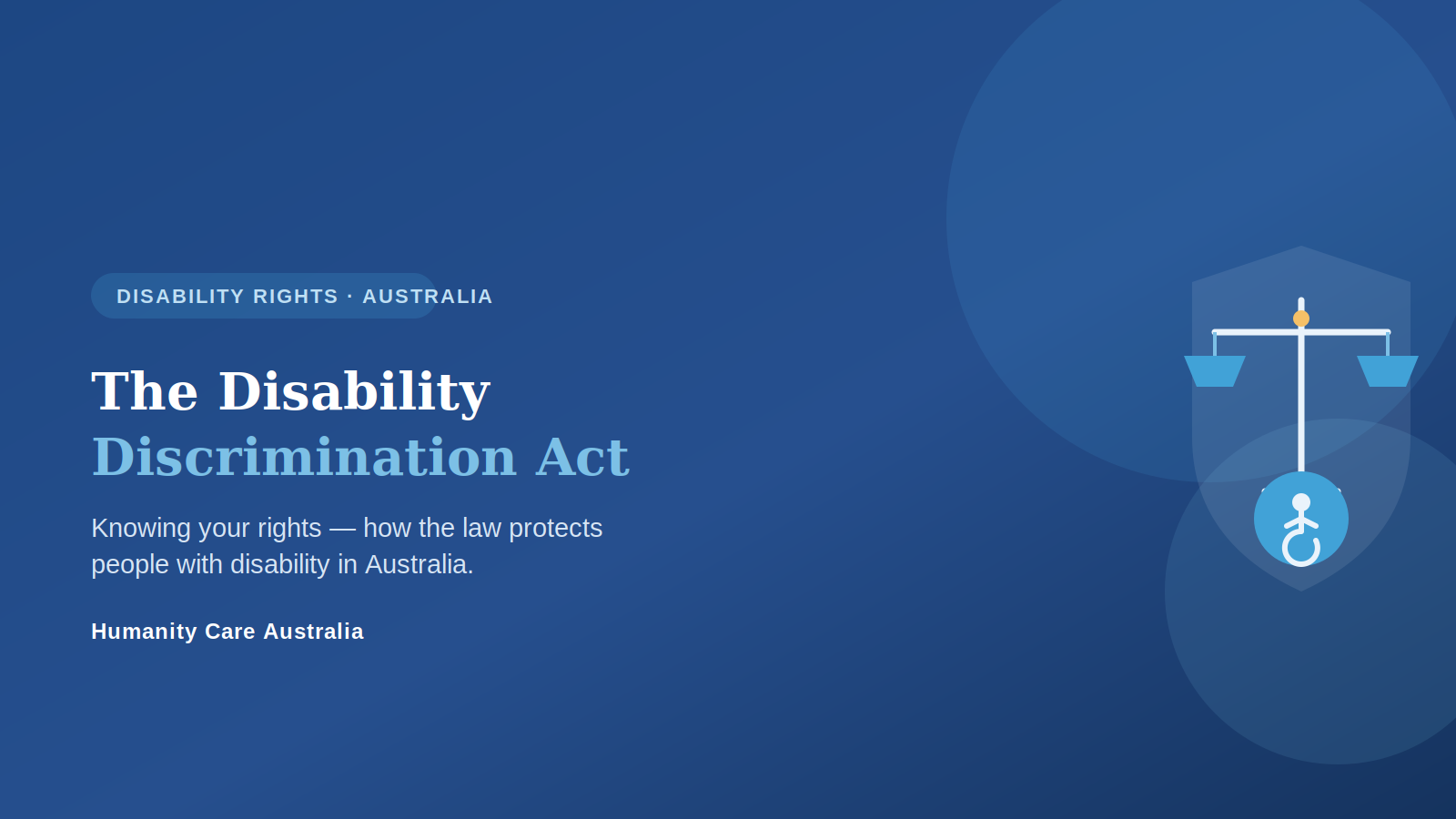
Everyone has the right to be treated fairly — and for people with disability in Australia, that right is protected by law. The Disability Discrimination Act 1992 is a cornerstone of disability rights, making it unlawful to discriminate against people because of disability. Understanding it helps people know their rights and stand up for them. This guide offers a clear, plain-language overview of the Disability Discrimination Act and what it means in everyday life.
This article provides general information about the Disability Discrimination Act for educational purposes. It isn’t legal advice, and every situation is different. If you’re dealing with a specific issue of disability discrimination, consider seeking advice from a legal professional, a disability advocate, or the Australian Human Rights Commission.
- The DDA makes disability discrimination unlawful — across many areas of public life.
- It covers areas like work, education and services — and access to premises.
- It protects against direct and indirect discrimination — both obvious and hidden.
- Complaints go to the Australian Human Rights Commission — a free, accessible process.
What is the Disability Discrimination Act?
The Disability Discrimination Act 1992 (often called the DDA) is a federal law that makes it unlawful to discriminate against a person because of their disability. Its purpose is to promote equal rights and opportunities for people with disability, and to protect them from unfair treatment across many areas of public life.
The DDA defines disability broadly — covering physical, intellectual, psychiatric, sensory, neurological and learning disabilities, as well as physical disfigurement and the presence of disease-causing organisms. It covers disabilities a person has now, had in the past, may have in the future, or is assumed to have. This broad definition means the Act protects a wide range of people.
The DDA was a genuine landmark when it was introduced — a clear national statement that people with disability have the right to participate fully and fairly in society. It reflects a simple but powerful principle: disability should never be a reason for someone to be treated as less than equal.
What areas does the DDA cover?
The Act makes discrimination unlawful across many areas of public life, including:
Employment
Hiring, conditions, training, promotion and dismissal — people can’t be treated unfairly at work because of disability.
Education
Schools, universities and other education providers must not discriminate, and are expected to make reasonable adjustments.
Goods & services
Access to shops, banks, healthcare, hospitality and other services must be fair and non-discriminatory.
Access & accommodation
Access to public premises, transport, and to housing and accommodation are all covered by the Act.
Direct and indirect discrimination
The DDA protects against two kinds of discrimination, and understanding the difference is important:
Direct discrimination
Treating a person less favourably than others because of their disability — the obvious kind. For example, refusing to serve someone because they have a disability.
Indirect discrimination
A rule or practice that seems neutral but unfairly disadvantages people with disability. For example, a venue with only stairs effectively excludes wheelchair users.
Indirect discrimination is often less obvious but just as important. Something can be discriminatory in its effect even if it wasn’t intended that way — which is why the Act looks at outcomes, not just intentions.
A key concept in the DDA is reasonable adjustments (sometimes called reasonable accommodations). Employers, educators and service providers are expected to make reasonable changes so people with disability can participate equally — like providing extra exam time, accessible formats, or flexible arrangements. Failing to make a reasonable adjustment can itself be discrimination.
Support to live life fully
Our Adelaide team supports people with disability to participate fully in their communities — with person-centred support that champions rights, dignity and inclusion.
Are there any exceptions?
The DDA does include some limited exceptions. For example, an adjustment isn’t required if it would cause “unjustifiable hardship” to the provider — though the bar for this is high, and it must be genuinely assessed, not simply assumed. There are also some specific exemptions in particular circumstances. Because these areas can be complex, they’re exactly the kind of thing worth getting proper advice on if they affect you.
What to do if you experience discrimination
If you believe you’ve experienced disability discrimination, you have options. The main pathway is making a complaint to the Australian Human Rights Commission (AHRC), which handles complaints under the DDA. Here’s the general process:
- The complaint is free — you don’t need a lawyer to make one, though you can get help.
- Conciliation comes first — the AHRC tries to resolve complaints between the parties.
- Support is available — disability advocates and legal services can help you through the process.
- Further options exist — if a complaint isn’t resolved, it may be able to proceed to court.
Facing discrimination can be stressful and isolating, but support exists. Disability advocacy organisations can help you understand your rights and options, and support you through making a complaint. The Australian Human Rights Commission’s website is also a helpful, accessible starting point for information.
Humanity Care believes in the rights, dignity and full inclusion of every person with disability. We provide person-centred disability support across Adelaide that champions independence and participation — supporting people to live full lives as equal, valued members of their community.
Frequently asked questions about the Disability Discrimination Act
What is the Disability Discrimination Act?
The Disability Discrimination Act 1992 (DDA) is a federal law that makes it unlawful to discriminate against a person because of their disability. It promotes equal rights and opportunities and protects people with disability from unfair treatment across many areas of public life, including employment, education, and access to goods, services and premises.
What areas does the DDA cover?
The DDA covers many areas of public life, including employment (hiring, conditions, promotion, dismissal), education, access to goods and services (shops, banks, healthcare, hospitality), access to public premises and transport, and housing and accommodation. It aims to ensure people with disability can participate fairly across society.
What’s the difference between direct and indirect discrimination?
Direct discrimination is treating someone less favourably because of their disability — the obvious kind. Indirect discrimination is a rule or practice that seems neutral but unfairly disadvantages people with disability, like a venue accessible only by stairs. Something can be discriminatory in its effect even if it wasn’t intended that way.
What are reasonable adjustments?
Reasonable adjustments (or accommodations) are changes that employers, educators and service providers are expected to make so people with disability can participate equally — such as extra exam time, accessible formats, or flexible arrangements. Failing to make a reasonable adjustment can itself be a form of discrimination under the DDA.
What can I do if I experience disability discrimination?
You can make a complaint to the Australian Human Rights Commission, which handles complaints under the DDA. The process is free, doesn’t require a lawyer, and starts with conciliation to try to resolve the matter. Disability advocates and legal services can support you. This is general information — for a specific situation, seek proper advice.
Does the DDA define disability broadly?
Yes. The DDA defines disability broadly, covering physical, intellectual, psychiatric, sensory, neurological and learning disabilities, as well as physical disfigurement and disease-causing organisms. It covers disabilities a person has now, had in the past, may have in the future, or is assumed to have — so it protects a wide range of people.
Rights worth knowing
The Disability Discrimination Act is a powerful protection — but rights are most useful when people know about them. Understanding that disability discrimination is unlawful, and that there are accessible ways to challenge it, helps people with disability stand up for fair, equal treatment in every part of life.
At Humanity Care, we’re proud to support people with disability to live full, included lives. If you’d like person-centred support in Adelaide that champions your rights and independence, our friendly local team is here to help.
Support that champions inclusion in Adelaide
Talk to our local team about person-centred support that helps you participate fully in your community — with no obligation.