Talk with us +0402 990 505
[email protected]
Mon to Fri: 8:00am to 5:30pm Sat-Sun: Closed
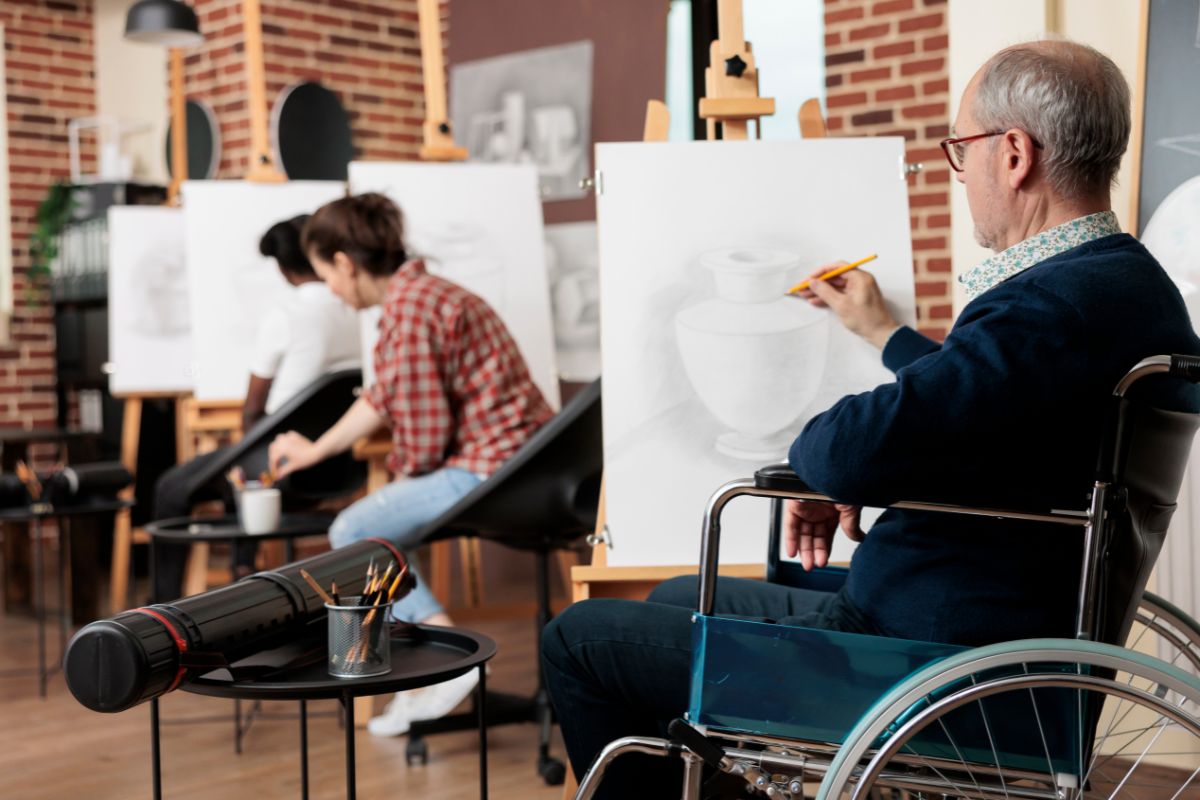
Connecting with others and sharing experiences are fundamental to a happy and fulfilling life. Our NDIS Group & Centre-Based Activities in Adelaide provide a safe, fun, and supportive environment for you to explore new hobbies, learn skills, and make lasting friendships.
Led by our trained support staff, these programs are designed to be inclusive and engaging. Whether you’re interested in art, cooking, sports, or simply socialising, our group activities offer something for everyone.
This NDIS support (funded under Core Supports) brings participants together in a community setting, either at a dedicated centre or a local venue.
Unlike one-on-one “Community Participation,” the focus here is on shared experiences. You and other participants engage in planned activities together, facilitated by our support workers. This is a fantastic way to build your social skills and confidence in a structured, safe environment.
Our programs are dynamic and often based on what our participants are interested in. We can run activities at a community hall, a local park, or a dedicated centre.
| Activity Type | Examples of Group Activities We Run |
|---|---|
| Life & Independent Skills | Group cooking classes, budgeting workshops, gardening, and computer skills basics. |
| Creative & Arts | Painting and craft workshops, music and jam sessions, drama groups, or a photography club. |
| Health & Wellbeing | Group fitness classes (like yoga or light exercise), wellness workshops, and healthy cooking. |
| Social & Recreation | Board game afternoons, movie days, trivia competitions, and group outings to local Adelaide attractions. |
Our group activities are perfect for NDIS participants who want to:
This service is a great way to reduce social isolation and become an active member of the community.
If you answered yes, joining one of our Adelaide group activities could be a perfect fit.
Group and Centre-Based Activities are most commonly funded under your Core Supports budget in the category: “Assistance with Social & Community Participation.”
The NDIS has different line items and price limits for group-based supports compared to one-on-one support. This can often be a more cost-effective way to use your NDIS funds to achieve your social goals.
Our team can work with you, your Support Coordinator, or Plan Manager to ensure the program costs are fully covered by your plan.
The ratio varies depending on the activity and the support needs of the participants. For example, a simple social gathering might have a 1:4 ratio, while a cooking class might have a 1:2 or 1:3 ratio to ensure everyone gets the help they need. We always maintain ratios that are safe and provide a high-quality experience.
This is a very common feeling, and our staff are trained to help. We can introduce you to the group slowly, perhaps starting with a smaller group or a one-on-one chat with the facilitator. Our goal is to make you feel welcome and comfortable at your own pace.
This depends on the specific program. Sometimes, transport to and from the centre can be arranged and funded by your NDIS plan (see our Transport Assistance service). For activities like cooking classes, the cost of ingredients is often included. We will always provide a clear schedule and list of any extra costs before you sign up.
We run our activities in various locations across Adelaide to be as accessible as possible. This can include community centres, local halls, or dedicated activity centres. When you enquire, we can let you know the current locations and timetables.

Ready to step out, learn something new, and make great friends? Contact our Adelaide team to find out more about our current group activities and how you can join.
Humanity Care Australia
We firmly believe that the internet should be available and accessible to anyone, and are committed to providing a website that is accessible to the widest possible audience, regardless of circumstance and ability.
To fulfill this, we aim to adhere as strictly as possible to the World Wide Web Consortium’s (W3C) Web Content Accessibility Guidelines 2.1 (WCAG 2.1) at the AA level. These guidelines explain how to make web content accessible to people with a wide array of disabilities. Complying with those guidelines helps us ensure that the website is accessible to all people: blind people, people with motor impairments, visual impairment, cognitive disabilities, and more.
This website utilizes various technologies that are meant to make it as accessible as possible at all times. We utilize an accessibility interface that allows persons with specific disabilities to adjust the website’s UI (user interface) and design it to their personal needs.
Additionally, the website utilizes an AI-based application that runs in the background and optimizes its accessibility level constantly. This application remediates the website’s HTML, adapts Its functionality and behavior for screen-readers used by the blind users, and for keyboard functions used by individuals with motor impairments.
If you’ve found a malfunction or have ideas for improvement, we’ll be happy to hear from you. You can reach out to the website’s operators by using the following email
Our website implements the ARIA attributes (Accessible Rich Internet Applications) technique, alongside various different behavioral changes, to ensure blind users visiting with screen-readers are able to read, comprehend, and enjoy the website’s functions. As soon as a user with a screen-reader enters your site, they immediately receive a prompt to enter the Screen-Reader Profile so they can browse and operate your site effectively. Here’s how our website covers some of the most important screen-reader requirements, alongside console screenshots of code examples:
Screen-reader optimization: we run a background process that learns the website’s components from top to bottom, to ensure ongoing compliance even when updating the website. In this process, we provide screen-readers with meaningful data using the ARIA set of attributes. For example, we provide accurate form labels; descriptions for actionable icons (social media icons, search icons, cart icons, etc.); validation guidance for form inputs; element roles such as buttons, menus, modal dialogues (popups), and others. Additionally, the background process scans all the website’s images and provides an accurate and meaningful image-object-recognition-based description as an ALT (alternate text) tag for images that are not described. It will also extract texts that are embedded within the image, using an OCR (optical character recognition) technology. To turn on screen-reader adjustments at any time, users need only to press the Alt+1 keyboard combination. Screen-reader users also get automatic announcements to turn the Screen-reader mode on as soon as they enter the website.
These adjustments are compatible with all popular screen readers, including JAWS and NVDA.
Keyboard navigation optimization: The background process also adjusts the website’s HTML, and adds various behaviors using JavaScript code to make the website operable by the keyboard. This includes the ability to navigate the website using the Tab and Shift+Tab keys, operate dropdowns with the arrow keys, close them with Esc, trigger buttons and links using the Enter key, navigate between radio and checkbox elements using the arrow keys, and fill them in with the Spacebar or Enter key.Additionally, keyboard users will find quick-navigation and content-skip menus, available at any time by clicking Alt+1, or as the first elements of the site while navigating with the keyboard. The background process also handles triggered popups by moving the keyboard focus towards them as soon as they appear, and not allow the focus drift outside it.
Users can also use shortcuts such as “M” (menus), “H” (headings), “F” (forms), “B” (buttons), and “G” (graphics) to jump to specific elements.
We aim to support the widest array of browsers and assistive technologies as possible, so our users can choose the best fitting tools for them, with as few limitations as possible. Therefore, we have worked very hard to be able to support all major systems that comprise over 95% of the user market share including Google Chrome, Mozilla Firefox, Apple Safari, Opera and Microsoft Edge, JAWS and NVDA (screen readers).
Despite our very best efforts to allow anybody to adjust the website to their needs. There may still be pages or sections that are not fully accessible, are in the process of becoming accessible, or are lacking an adequate technological solution to make them accessible. Still, we are continually improving our accessibility, adding, updating and improving its options and features, and developing and adopting new technologies. All this is meant to reach the optimal level of accessibility, following technological advancements. For any assistance, please reach out to