Money is where most families freeze. The idea of paying for care — on top of everything else — feels daunting. So here’s the reassuring truth up front: for most Adelaide families, government-funded respite costs far less than you’d expect, and often little or nothing out of pocket. The support itself is heavily subsidised; where you do contribute, it’s usually a modest amount toward everyday costs like meals.
This guide breaks down what respite actually costs in Adelaide in 2026 — across aged care and the NDIS — so you can plan with confidence.
A note on pricesRespite fees and rates change — they’re reviewed regularly and depend on your funding, your provider, and your individual circumstances. The figures below are indicative 2026 guides to help you plan. Always confirm the exact cost with your provider and the official source before booking.
Key Takeaways
- Funded respite is heavily subsidised — the government covers most of the cost, so out-of-pocket amounts are usually small.
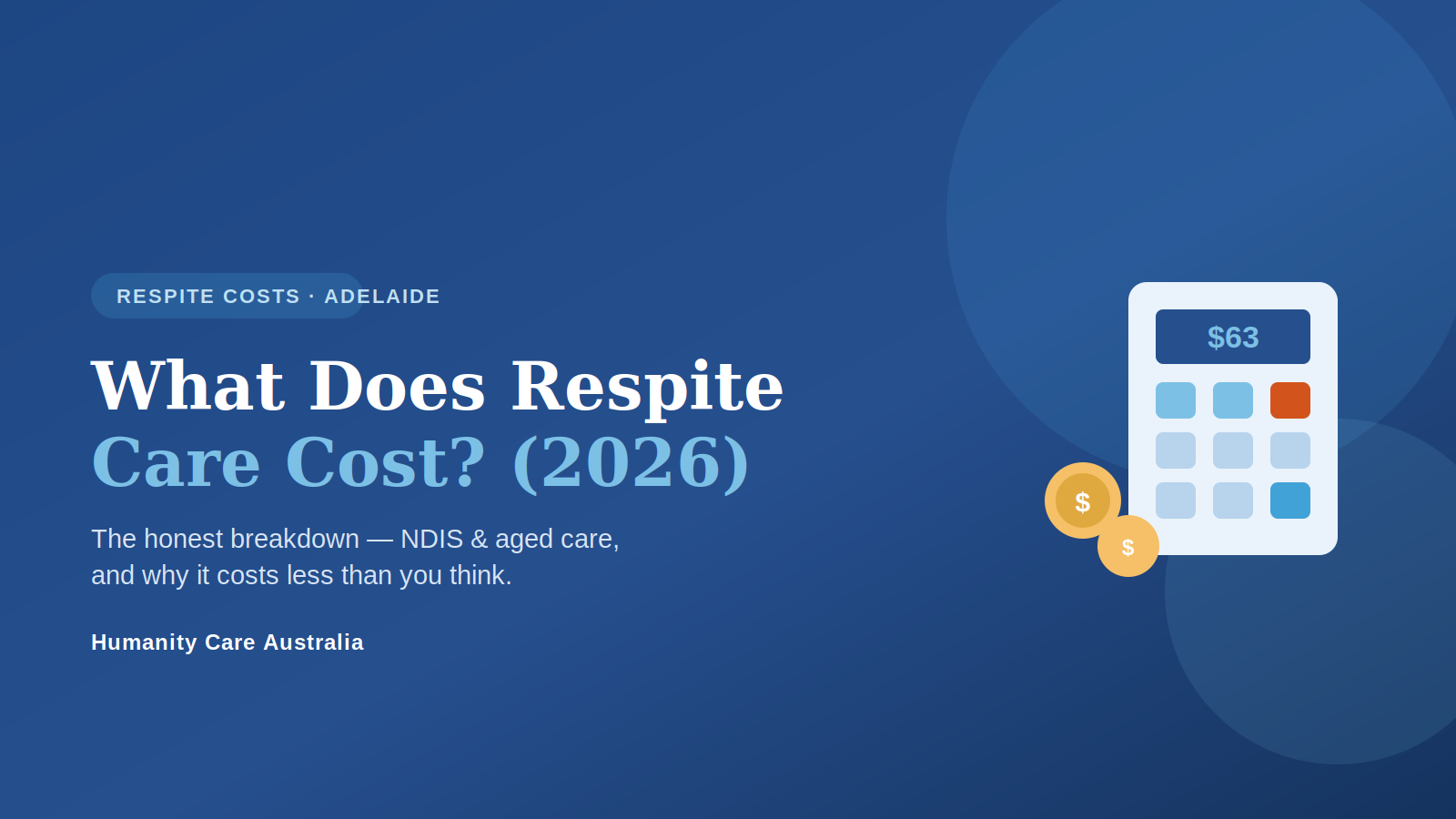
- Aged care residential respite costs around $63 a day (a basic daily fee) — with no means-tested fee and no accommodation deposit, unlike permanent care.
- In-home respite through CHSP is typically a low subsidised contribution, often around $10–$15 an hour.
- NDIS respite is funded through your plan — the support is covered, so most participants pay nothing out of pocket.
How much does respite care cost in Adelaide?
There’s no single price, because respite is funded two different ways — through aged care (for older Australians) and the NDIS (for people with disability) — and the cost depends on the type of respite and your circumstances. Here’s the quick picture, then we’ll break each one down.
| Type of respite | Indicative 2026 cost | Funded through |
|---|---|---|
| In-home respite (aged care) | ~$10–$15 per hour (subsidised) | CHSP / Support at Home |
| Centre-based day respite | Low daily contribution | CHSP / Support at Home |
| Residential respite (aged care) | ~$63 per day (basic daily fee) | Government-subsidised |
| NDIS respite (Short Term Respite) | Covered by your plan | NDIS Core Supports |
Aged care respite costs
If the person needing care is an older Australian, respite is funded through the aged care system — and this is where families are most often relieved by how affordable it is.
Residential (overnight) respite
For a short stay in a residential aged care home, you pay a basic daily fee — around $63 a day in 2026 (set at 85% of the single basic age pension, and reviewed each March and September). Crucially, unlike moving into permanent care, there is no means-tested fee and no accommodation deposit (RAD/DAP) for respite, and you don’t need to complete an income and assets assessment. That makes residential respite dramatically cheaper than many families fear.
In-home & centre-based respite
For respite at home or at a day centre, costs are funded through the Commonwealth Home Support Programme (CHSP) or the Support at Home program. Contributions are modest — in-home respite is often around $10–$15 an hour with the government subsidy applied, and day centres charge a low daily fee that usually includes meals and activities. If you’re on Support at Home, respite is drawn from your overall funding allocation.
Good to knowIf you’re finding the fees difficult to manage, financial hardship assistance may be available for aged care respite. The government can cover part or all of your respite fees if you qualify. Ask My Aged Care or your provider about the financial hardship provisions.
NDIS respite costs
If the person needing care is an NDIS participant, respite is funded through their plan — which means the support itself is generally covered, and most participants pay nothing out of pocket for it.
Overnight respite on the NDIS is funded as Short Term Respite (STR) — this was renamed from Short Term Accommodation (STA) in late 2025, so you may still see both terms used. STR covers accommodation, personal care, meals and activities for a short stay, and is funded under Core Supports. It’s generally available for up to around 28 days a year, with a maximum of 14 consecutive days per stay.
The daily rate a provider claims from your plan depends on the level of support you need, the day of the week (weekends and public holidays cost more), and whether support is one-to-one or shared. The key point for families: because this comes out of your NDIS funding rather than your pocket, your job is to make sure STR is included in your plan — not to worry about a daily bill. Your support coordinator can help you check and use it.
Sharing can stretch your fundingNDIS respite delivered in a shared setting — where two or more participants stay together and share support — can reduce the daily cost per person, which means your funded days may go further. It’s worth discussing shared options with your provider if it suits your loved one.
From Humanity Care
Not sure what respite will cost you?
Our Adelaide team can look at your funding — NDIS or aged care — and give you a clear, honest picture of what you’d actually pay, with no obligation.
What’s included in the cost (and what’s extra)
A respite daily rate usually bundles the essentials, but it’s always worth asking a provider exactly what’s covered so there are no surprises.
Usually included
Support and supervision, personal care, meals, and everyday activities during the stay or visit.
Sometimes extra
Special outings or activities, transport, and optional “hotel-type” services like pay TV in residential respite.
How to find out your exact cost
Because every plan and situation is different, the only way to know your precise cost is a quick conversation with a provider who can look at your funding. Here’s the simplest path:
1. Confirm your funding
NDIS (check your plan for Short Term Respite) or aged care (via a My Aged Care assessment). Not sure? We’ll help you work it out.
2. Ask for a clear breakdown
A good provider will explain the daily rate, what’s included, and any weekend or public-holiday differences before you commit.
New to respite? Start with the basics
If you’re just beginning to explore respite, our pillar guide covers what respite is, the different types, and how to access it: What Is Respite Care? A Complete Guide for Adelaide Families. If you’d prefer a break where your loved one stays home, see our guide to in-home respite care in Adelaide.
Frequently asked questions about respite care costs in Adelaide
How much does respite care cost per week in Adelaide?
It depends on the type and your funding. For aged care residential respite, the basic daily fee is around $63 a day, so roughly $440 a week — with no means-tested or accommodation costs. In-home aged care respite is often around $10–$15 an hour. NDIS respite is funded through your plan, so most participants pay nothing out of pocket.
Is respite care free in Australia?
It’s heavily subsidised rather than entirely free. The government covers most of the cost. For aged care residential respite you pay a modest basic daily fee (around $63); for in-home respite you may pay a small hourly contribution. Under the NDIS, the support is funded through your plan, so it’s typically free to you.
Do I pay an accommodation deposit for respite care?
No. Unlike moving permanently into aged care, residential respite has no Refundable Accommodation Deposit (RAD) or Daily Accommodation Payment (DAP), and no means-tested fee. You only pay the basic daily fee, which makes respite far cheaper than permanent care.
Does the NDIS pay for respite care?
Yes. NDIS respite is funded as Short Term Respite (STR, formerly called Short Term Accommodation or STA) under Core Supports. It covers accommodation, personal care, meals and activities for a short stay, generally up to around 28 days a year. The cost comes from your plan, not your pocket.
What if I can’t afford the respite fees?
Financial hardship assistance may be available for aged care respite — the government can cover part or all of your fees if you qualify. Speak to My Aged Care on 1800 200 422 or your provider about the hardship provisions. Our team can also help you understand your options.
Why do respite prices vary so much online?
Because they mix up funded and private costs. Government-subsidised respite (aged care or NDIS) is far cheaper than paying privately. Private respite can run into hundreds of dollars a day, but most Adelaide families access funded respite and pay only a small contribution — or nothing. Always check which type a quoted price refers to.
The bottom line on respite costs
For most Adelaide families, cost is far less of a barrier than it first appears. Funded respite — whether through aged care or the NDIS — is designed to be affordable, precisely because a rested carer is able to keep caring. The best next step is simply to find out your own numbers, which we’re happy to help with.
Ready when you are
Get a clear picture of your respite costs
Talk to our local Adelaide team about your NDIS or aged care funding, and we’ll help you understand exactly what respite would cost you — with no obligation.